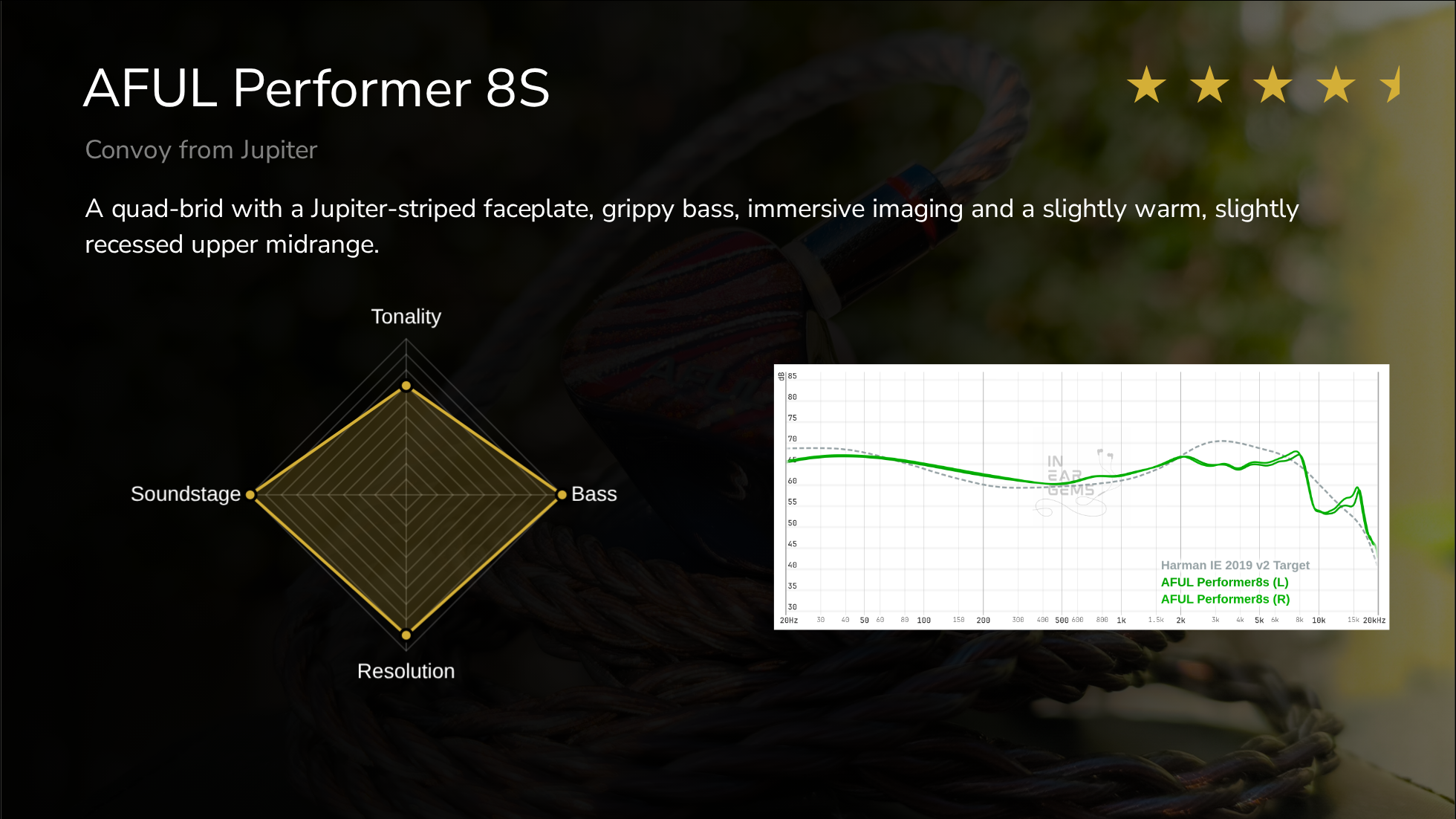
AFUL Performer 8S - Convoy from Jupiter
The AFUL Performer 8S is the rare IEM I have reviewed twice. The first assessment began at release but was cut short by burnout and a months-long hiatus from anything audio. Now, with a freshly revised methodology and a different head for listening, I come back to this IEM, probably way too late in the fast moving world of personal audio. So, how does P8s still fare?
Forewords
- What I look for in an IEM is immersion. I want to feel the orchestra around my head, track individual instruments, and hear all of their textures and details. I’m not picky about tonality, as long as it does not make the orchestra, violin, cellos, and pianos sound wrong.
- I rate IEMs within with a consistent scale from 1 (Poor) to 3 (Good) to 5 (Outstanding). An overall ranking of 3/5 or above is considered positive.
- Ranking list and measurement database are on my IEM review blog.
- The terminology for subjective impressions in this review is based on the Audio Wheel for reproduced sound defined in the technical report ITU-R BS.2399-0
- This review is based on a pre-production sample from Hifigo (Thank you!). I have no affiliation with or financial interest in AFUL.
- The unit retails for $370.49 at Hifigo at the time this review was published. Unaffiliated link: Hifigo
In the Box
The Performer 8S arrives in a box that feels noticeably more upmarket than what AFUL shipped with their previous generation. The presentation is at the level I expect for a $400 IEM, which is fair given how the hobby has shifted in 2026. Previously, AFUL’s packaging sat below my expectation. This one finally catches up to where it should be for a high-end consumer product.
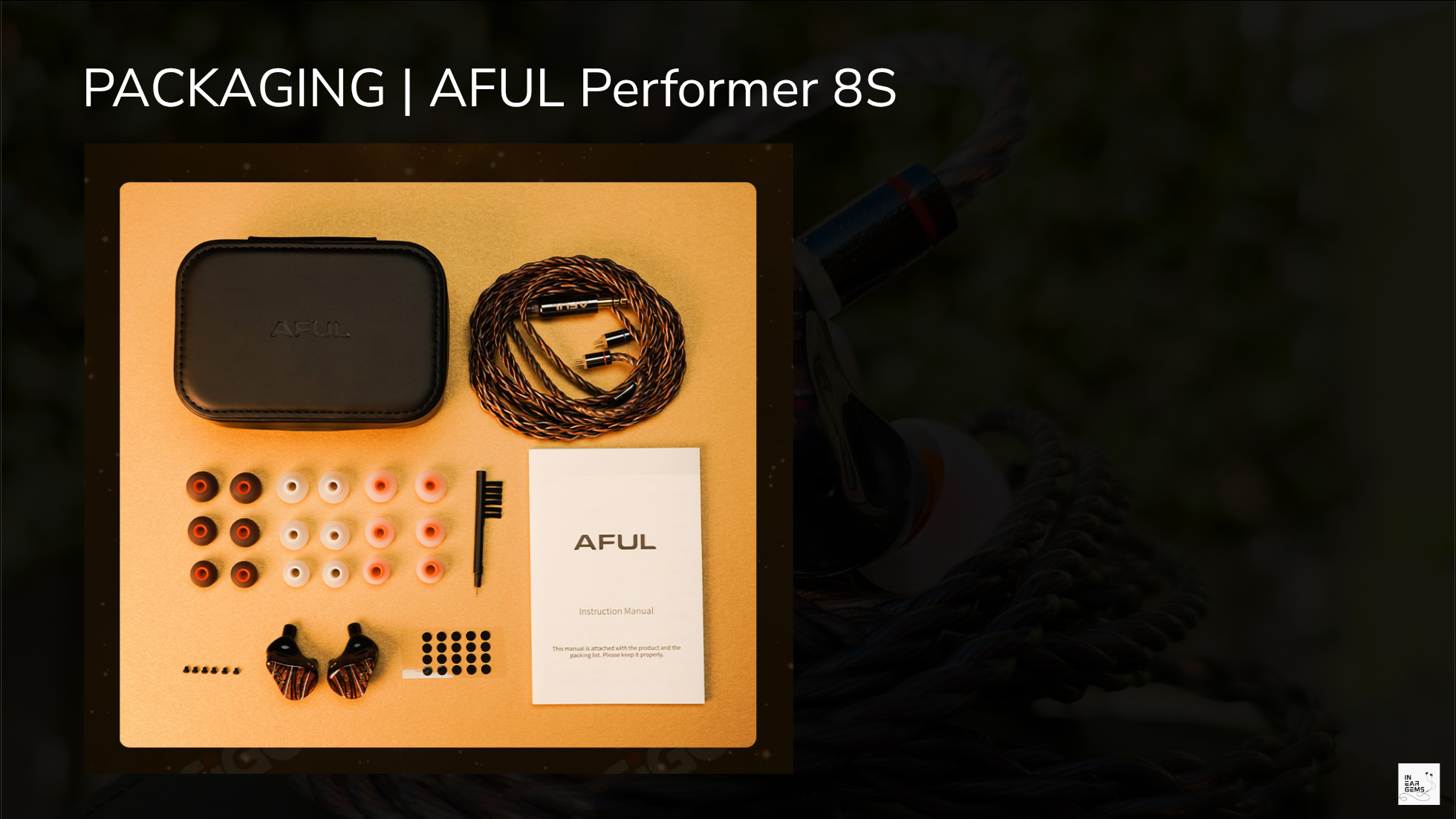
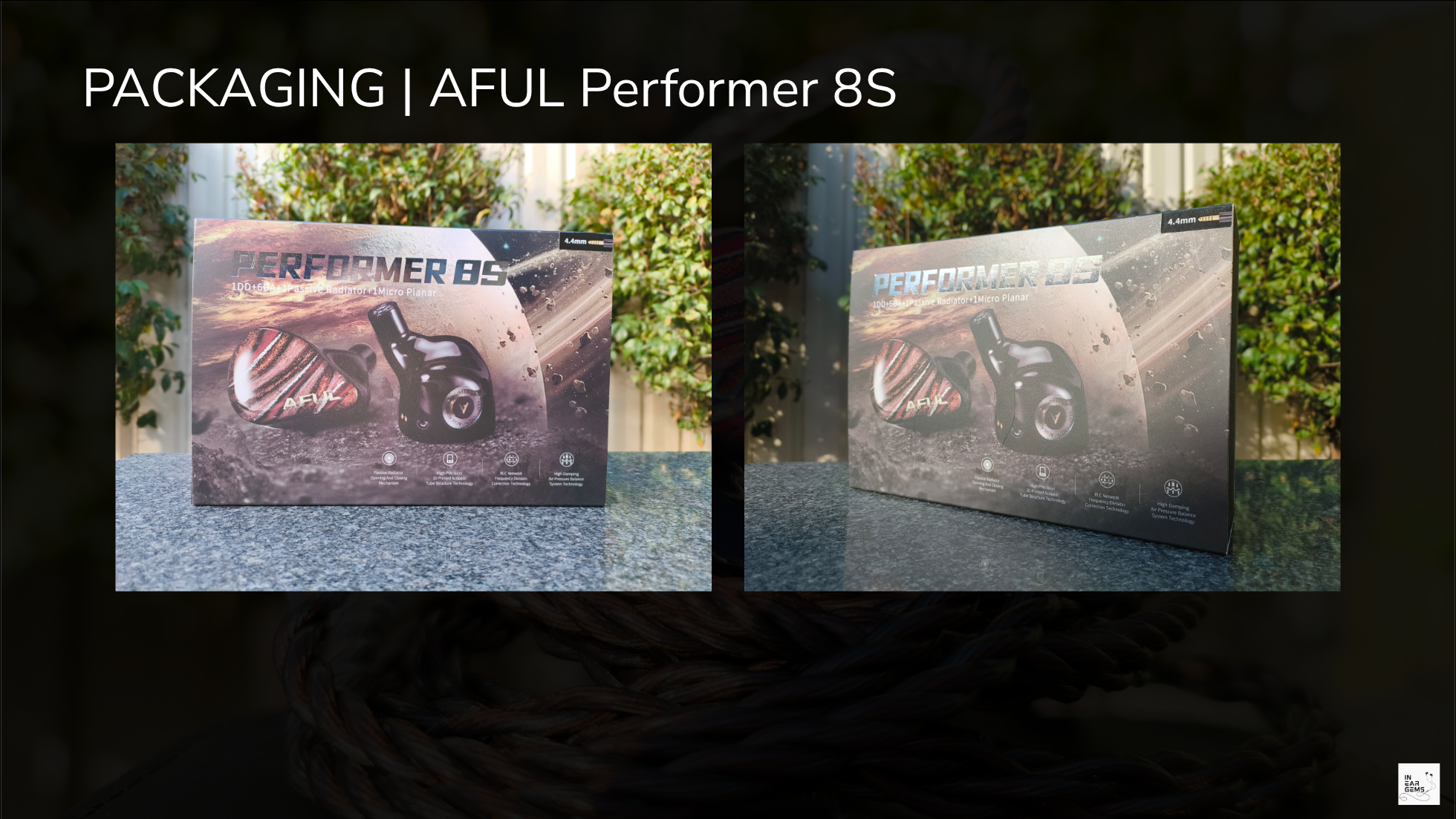
Inside, I find:
- The IEM earpieces themselves
- A six-strand stock cable in either 3.5 mm or 4.4 mm termination, terminated in 0.78 mm 2-pin
- A faux leather carry case
- Three sets of silicone ear tips
- A cleaning tool
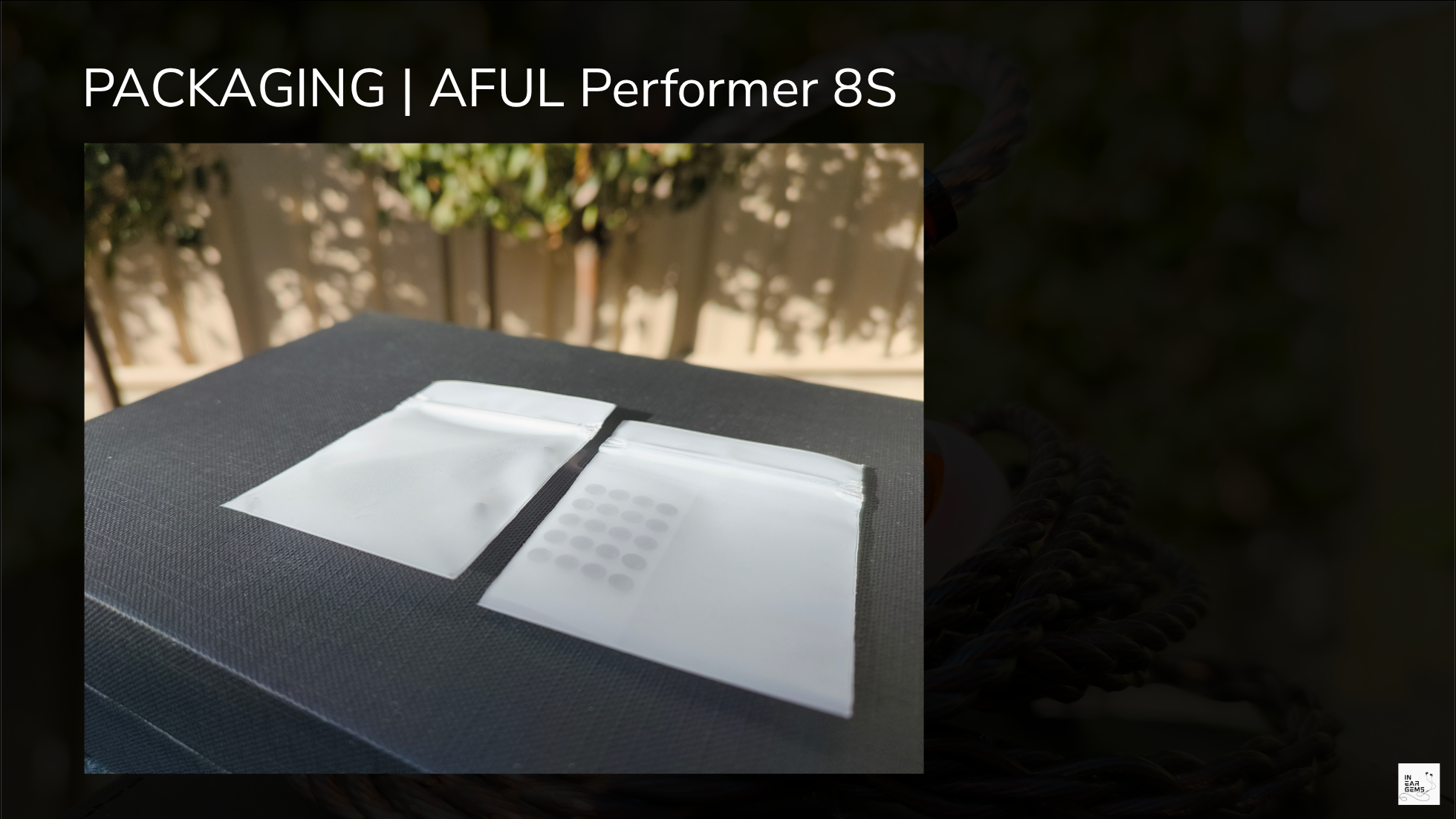
- Replacement no-mark stickers and silicone plugs that pair with the new tunable bass port system
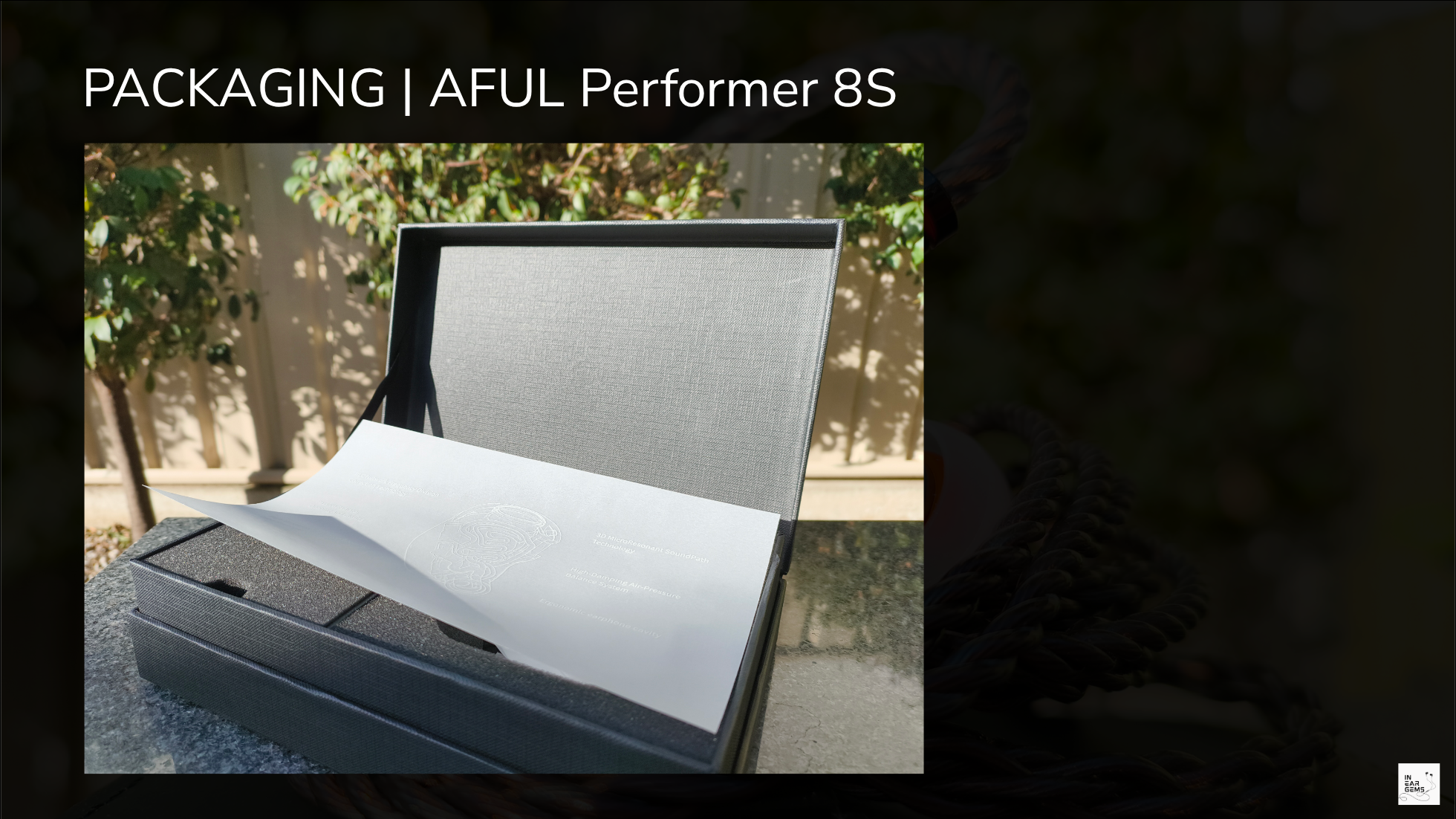
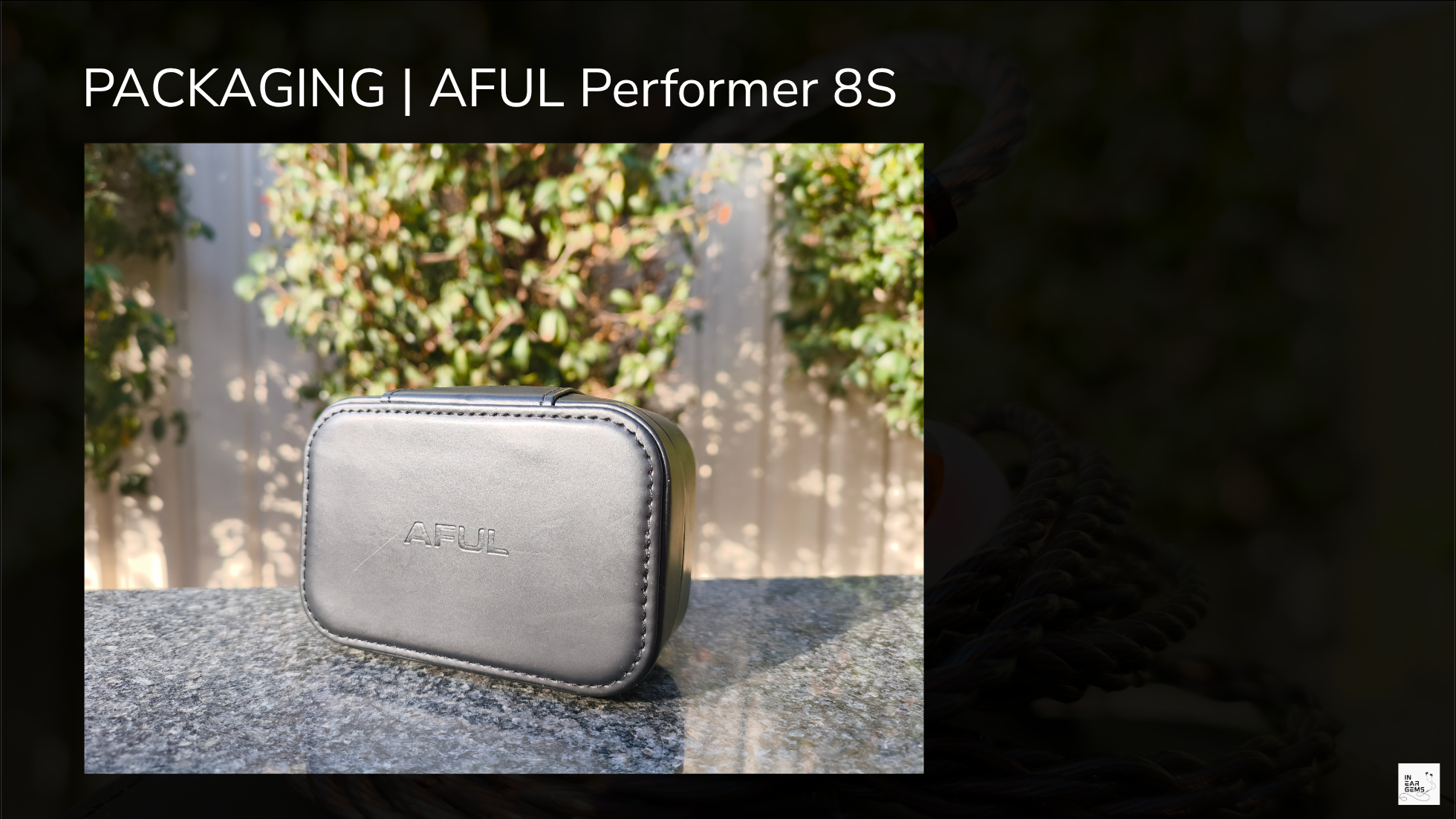
The case is where AFUL’s price-tier concessions become obvious. It is the same case shipped with the Performer 7, not the more luxurious leather case that comes with the Cantor or Dawn-X. Practical and protective, but not standout. The cables, tips, and tools cover what I need to get started. The sticker-and-plug pair supports the new passive radiator tuning switch without requiring extra accessories to be on hand.
General Information
The Performer 8S is a quad-brid IEM, pairing one dynamic driver with six balanced armatures, one passive radiator, and one micro planar magnetic driver. Per AFUL, the standout feature is the adjustable passive radiator, which lets the user switch between two bass tunings: a closed mode for solid, atmospheric, punchy bass, and an open mode for a deeper, more elastic, and softer character. The switch is mechanical, not electronic and not a swappable nozzle.
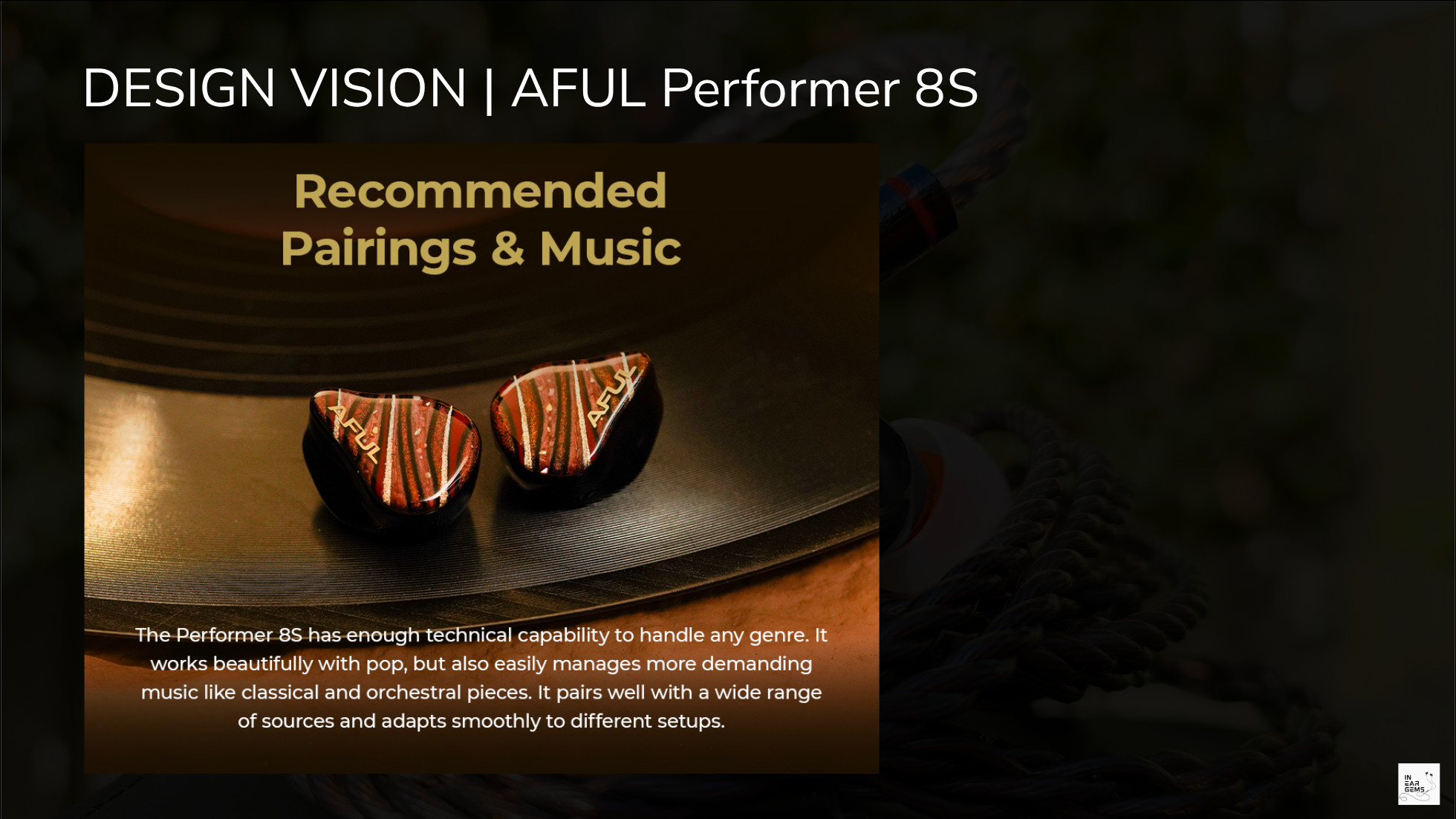
Beyond the driver layout, AFUL relies on their usual in-house tech for electronics and physical tuning. There is the patented RLC (resistor-capacitor-inductor) network crossover, which they describe as refining the nine-driver array and eliminating resonance peaks. There is the RESInator micro-resonance technology, which uses 3D-printed acoustic pathways inside the shell to correct non-ideal driver behaviour. And there is the high-damping pressure-balanced venting, which splits the tuning and pressure-relief functions into independent acoustic paths so that sealing the tuning vent does not build ear pressure. The faceplates are designed after the echoes of Jupiter, which is aesthetic, not technical.
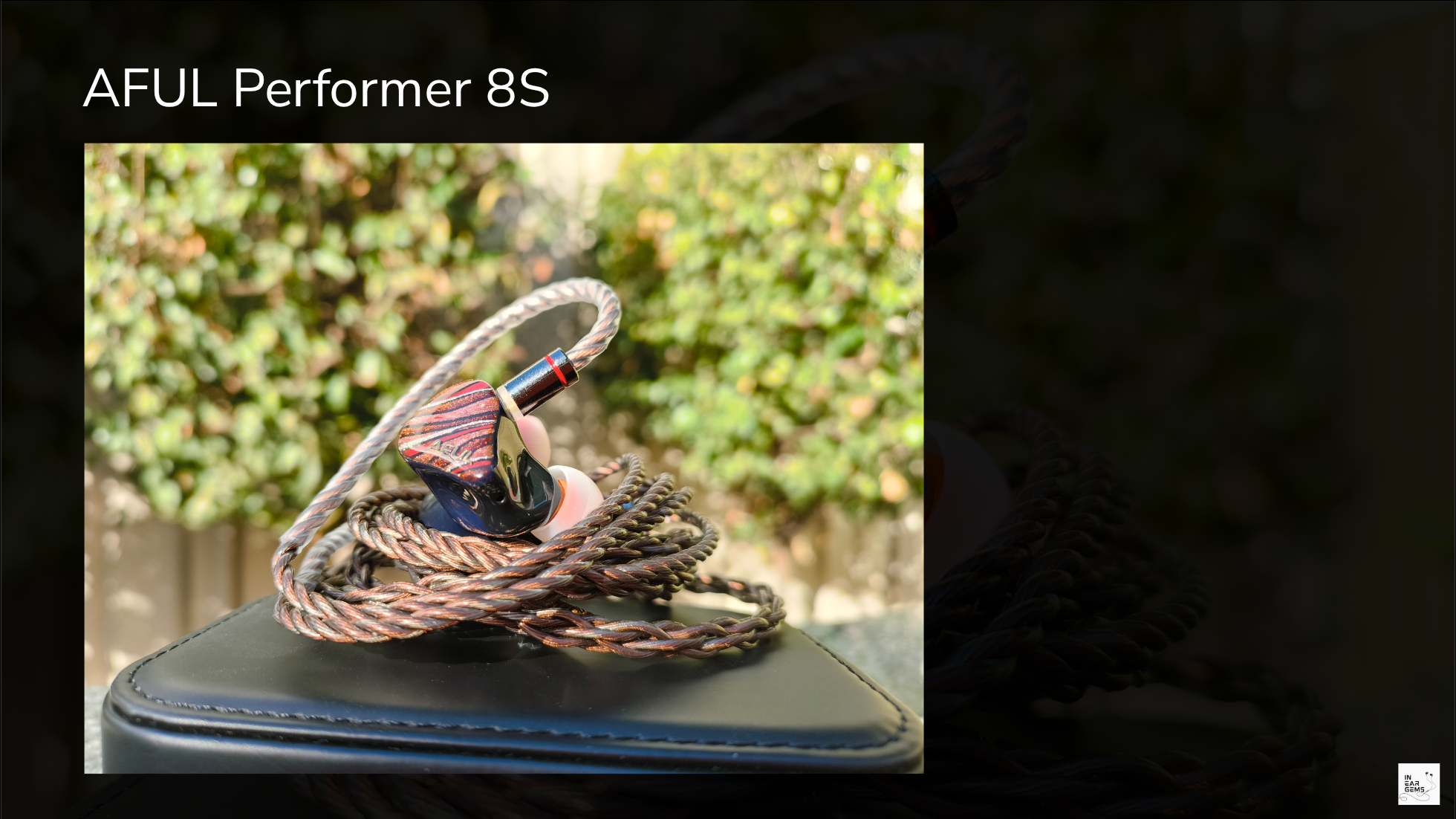
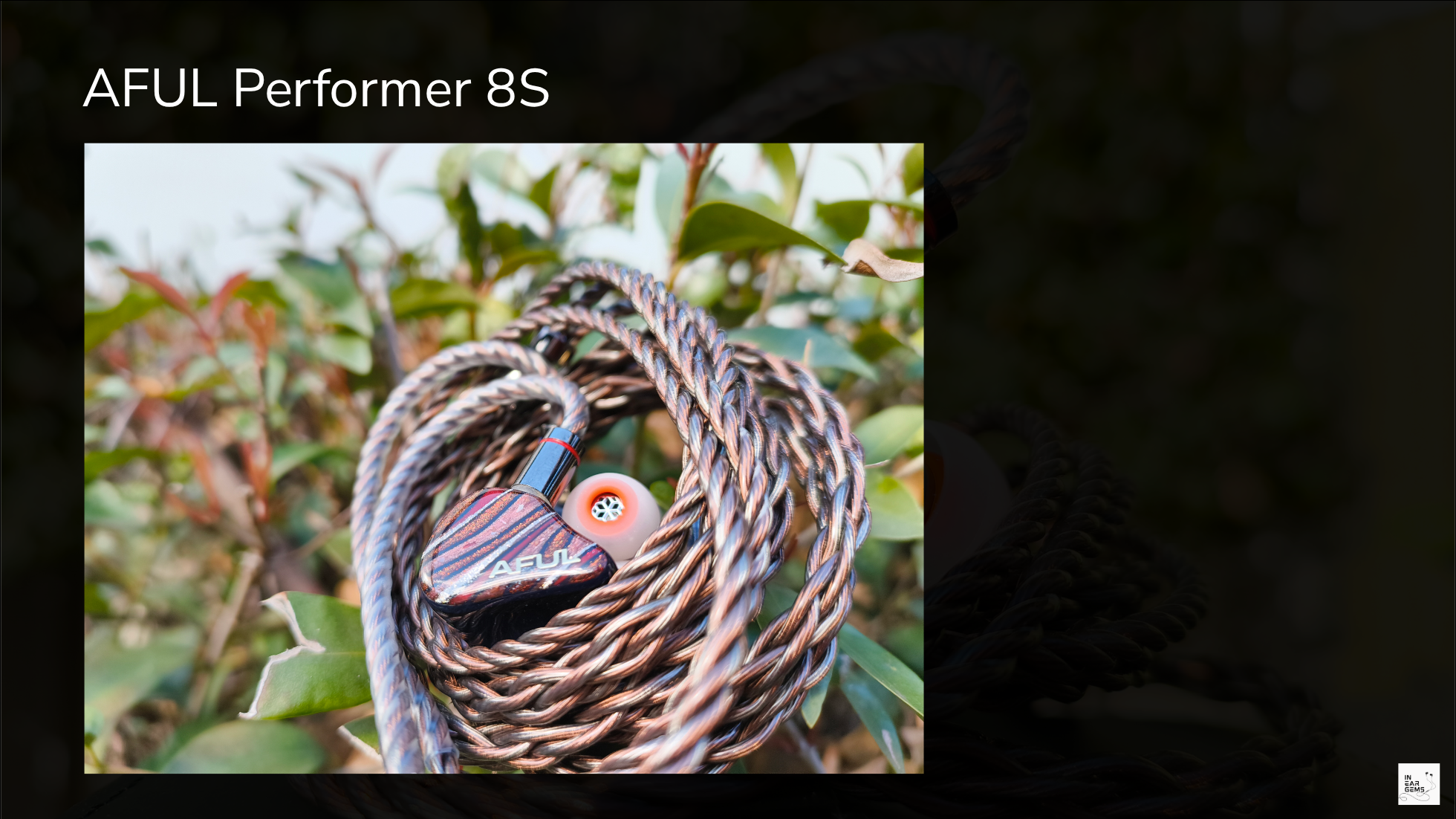
Build-wise, the earpieces are 3D-printed in medical-grade resin, with a 0.78 mm 2-pin connector for cable swappability. The stock cable is a six-strand, 392-core hybrid of silver-plated 4N single-crystal copper and plain single-crystal copper, terminating in either 3.5 mm single-ended or 4.4 mm balanced depending on the SKU.
| Spec | Value |
|---|---|
| Driver configuration | 1 DD + 6 BA + 1 passive radiator + 1 micro planar (per side) |
| Impedance | 26Ω ± 20% |
| Sensitivity | 108 dB @ 1 kHz (units not stated by vendor) |
| Frequency response | 10 Hz to 35 kHz |
| Connector | 0.78 mm 2-pin |
| Cable termination | 3.5 mm or 4.4 mm (SKU-dependent) |
| Shell material | 3D-printed medical-grade resin |
AFUL pitches the Performer 8S as easy to drive, and the 108 dB sensitivity figure at 1 kHz is consistent with that claim. The catch is that AFUL does not state whether the figure is in dB/mW or dB/Vrms, which matters at this impedance. I find that the claim holds up. The IEM does not hiss from overly sensitive behaviour, and there is enough range of volume adjustment to find a comfortable level. That said, it has enough resistance that a good DAP or amplifier helps bring out a bit of extra performance.
Physical Handling
I have been daily-driving the Performer 8S for long stretches without any urge to take a break. The fit works for multi-hour sessions with no hot spots, no pressure buildup, and no pain points. Noise isolation is average for a vented IEM. Nothing leaks in either direction, but it does not stand out from the competition.
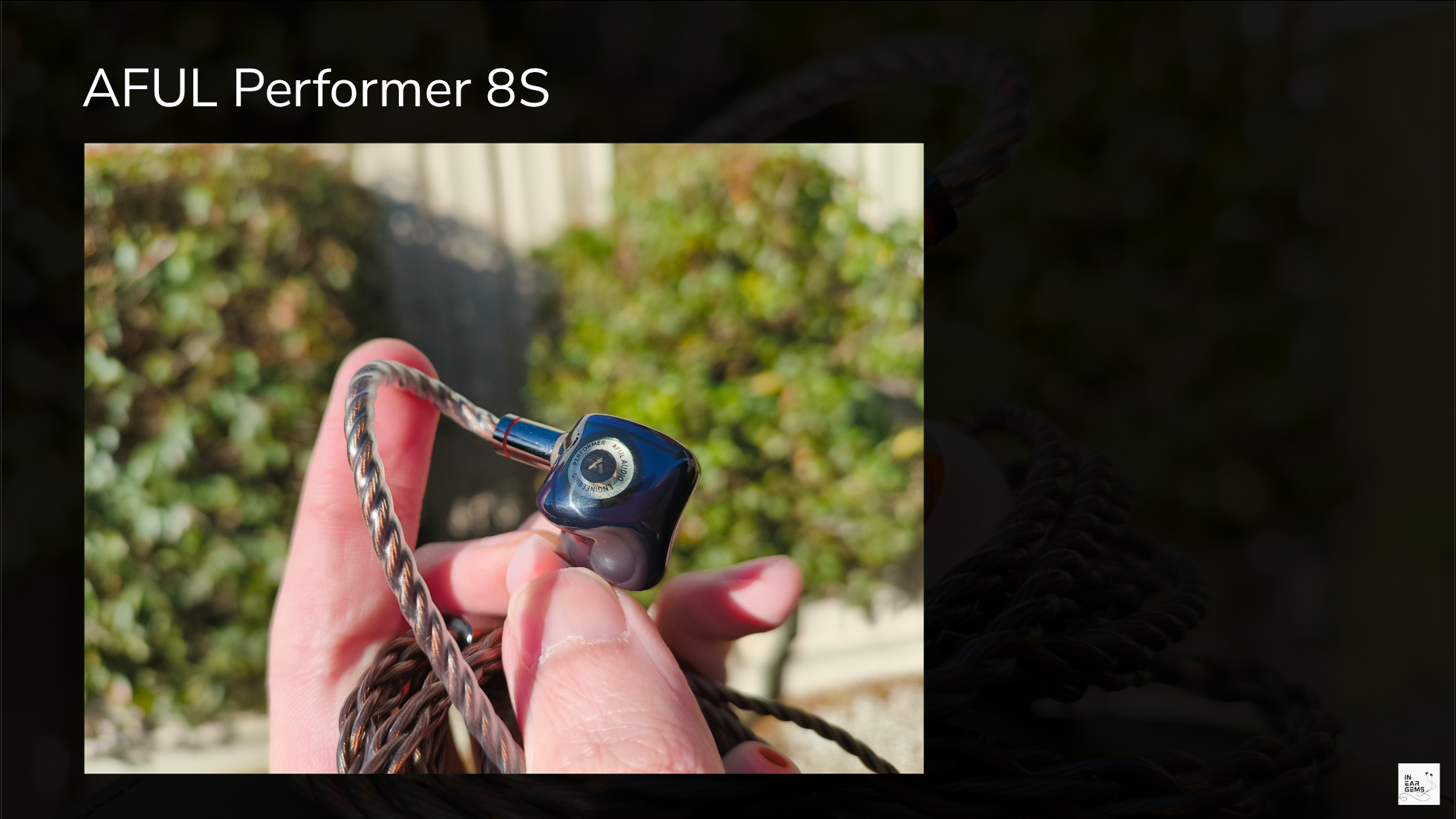
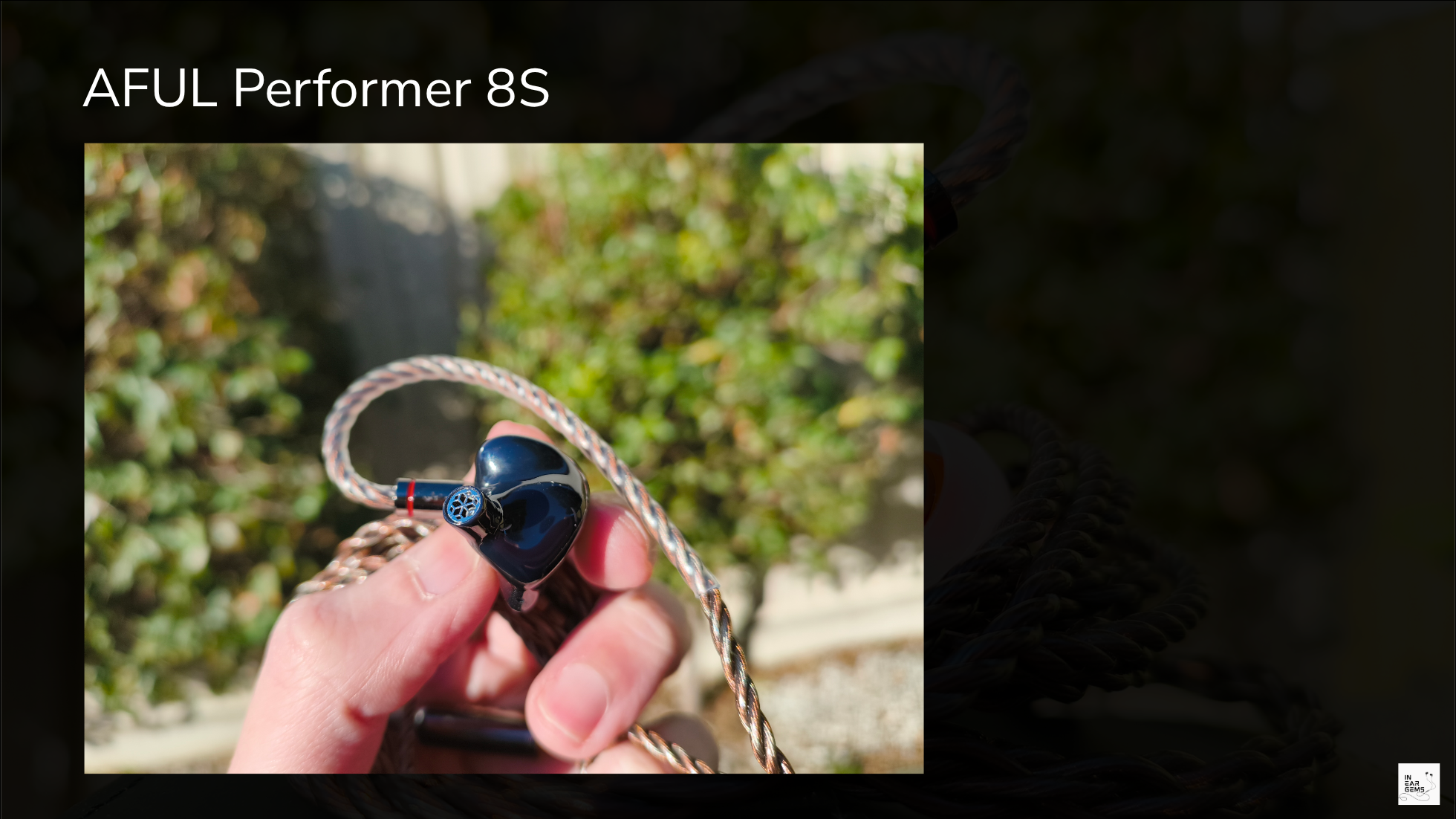
The one nitpick I have is the nozzle. AFUL used to design narrower nozzles on their IEMs, including the Performer 7. The Performer 8S uses the wider nozzles that have become industry standard for this tier, which is fine, though I would have preferred AFUL hold the older profile. The stock silicone tips work well out of the box and are a good fit. If I had to recommend a roll, it would be the Eletech Baroque. The trade-off is meaningful. The Baroque gives a small gain in transparency, clarity, and the precision of instrument positioning within the stage, but it shortens the nozzle-plus-tip assembly so the IEM body sits flush against the ear, which in turn makes the soundstage slightly less spread out. Sancai Wide bore does much the same thing and is a good alternative. I tried the Divinus Velvet Wide Bore as well, and it did not seal on this shell, killing most of the bass body and impact. Spinfit W1 had the strongest isolation and crisped the tone slightly, but reduced bass impact, so it is a niche choice for listeners who want crisper treble and tighter seal at the cost of bass weight.
Sound Signature & Tonal Balance
The Performer 8S lands as a slightly warm, neutral-leaning IEM with a tilt that reads as artistic rule-bending rather than strict neutrality. The energy across the upper midrange and treble is present but sits a touch recessed compared to a strictly neutral reference, and the bass has body without bleeding into the lower mid. There is more musical richness here than flat accuracy, and the trade-off is real. On already-bright material, the upper-mid bite is slightly softened. On already-warm material, the lower-mid energy can make elements clump together at the loudest peaks.
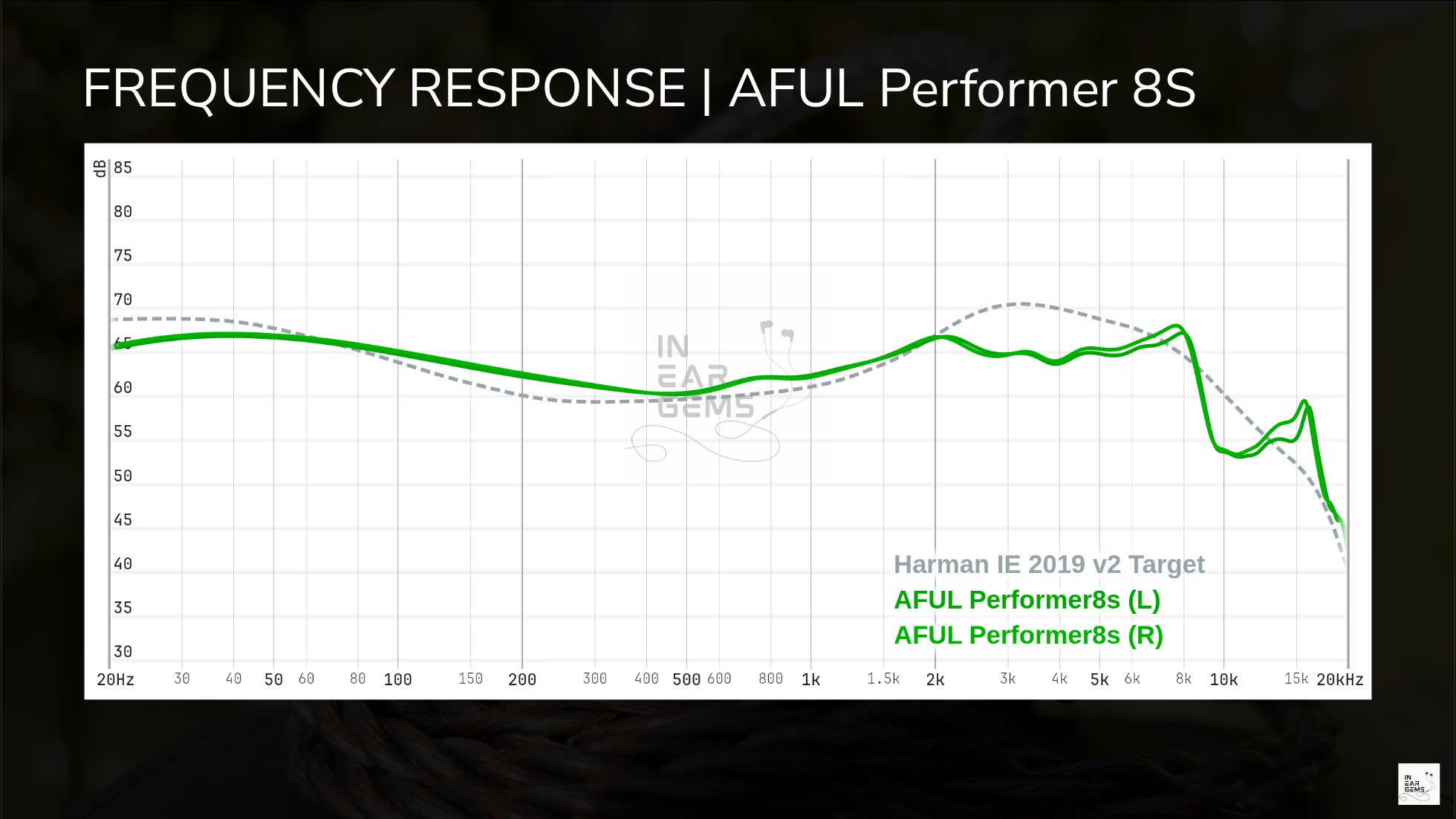
AFUL’s particular midrange tuning shows up early in a listening session. They push the region around 800 to 1250 Hz earlier than most IEMs, which means listeners coming from a typical ear-gain compensated signature will find the first moments a touch strange. The shift is not wrong, but it asks the ear to recalibrate. Once it does, the rewards come through.
On Shivers by Ed Sheeran, the test track I use for sibilance and harshness, the Performer 8S comes through with zero harshness or sibilance. At the same time, the side-channel backing vocals, the small breaths in Ed’s voice, and the higher-frequency nuances are clearly audible. Ed’s voice lands with emotive warmth and richness, sitting at the upper edge of what I would call neutral-warm. If there were a touch more energy in the lower mid, I would start complaining, but in this state it is just right.
Female vocals are equally well-served. On Kiwi wa Boku ni Niteiru by See-Saw, Chiaki Ishikawa’s voice is bright, vibrant, and clear without edging into harshness. The neutral-warm midrange gives her voice a musical richness that pairs nicely with the recording. The overdub on this track, the layered backing vocal, comes through with all the nuance and detail intact.
Strings and orchestra are rendered with body and authority, though the warmth is a double-edged sword here. On Now We Are Free by 2CELLOS, the cellos carry the rumble and resonance of the body, and the lower-midrange does not go thin. The same warmth, however, makes the cellos tone feel a touch muffled in some passages.
On Ciaccona from Bach’s Violin Partita No. 2 in D Minor, performed by Kavakos, the violin’s hall decay and breath are audible, dynamic variation is well-rendered, and the warmth slightly reduces the exposed scratchiness of the bow on the strings compared to a strictly neutral IEM like the Cantor. Some listeners will prefer this more musical tone. I do not mistake it for a lack of details. All the details that would satisfy careful, deliberate listening are present.
On Synchro BOM-BA-YE by Tokyo Kosei Wind Orchestra, the hand claps at the beginning are crisp and detailed with a good sense of resonance. The brass and woodwind have plenty of details when I pay attention, the foreground layering over the bass instruments is clean, and the bass and drums are authoritative. The energy level reads slightly muted compared to a strictly neutral IEM, which I noted as a downside for listeners who want a brighter and more forward sound. The cymbals and hats on Playing God by Polyphia are detailed and not harsh, with clear decay on the crashes and distinct hits on the hats. The bass guitar has good but not overbearing presence, with details audible on attention rather than a low-pitched hum.
On Bach’s Goldberg Variations, recorded by Lang Lang, the piano is balanced across registers. High notes cut through without harshness, the left hand is easy to follow and not overpowered by the highs, and the interplay between voices can be tracked with attention. The overall tone across the board is slightly warm, again reading as artistic rule-bending rather than strict correction.
The Performer 8S does not have swappable tuning switches or nozzles beyond the mechanical PR mode I discussed in the General Information section. For this review I tested in the closed (default) PR mode throughout.
Resolution
The Performer 8S is a resolving IEM, and the resolution story plays out across my test tracks with consistent evidence. On ABC feat. Sophia Black by Polyphia, the chaotic whole lands cleanly in cursory listening without anything overly mushing. When I slow down and pay attention, I can identify and trace any individual part of the track, including the faint Sophia Black overdub on the side channels from the opening.
Micro details surface without effort across my library. On Ciaccona from Bach’s Violin Partita No. 2 in D Minor, performed by Kavakos, the breath of the violinist, the violin’s hall decay, and the dynamic variation across the piece are all clearly resolved. The same goes for the side-channel backing vocals and the breaths in Ed’s voice on Shivers, the bass-brass details in Synchro BOM-BA-YE, and the way the polyphia guitar layers stay distinct on Playing God.
The one weakness shows up in the loudest, most cluttered moments. On the busier sections of Strength of a Thousand Men (Live) by Two Steps from Hell, elements start to clump together. I cannot fully separate whether this is the warmth getting in the way or a ceiling of the IEM, but the effect is small.
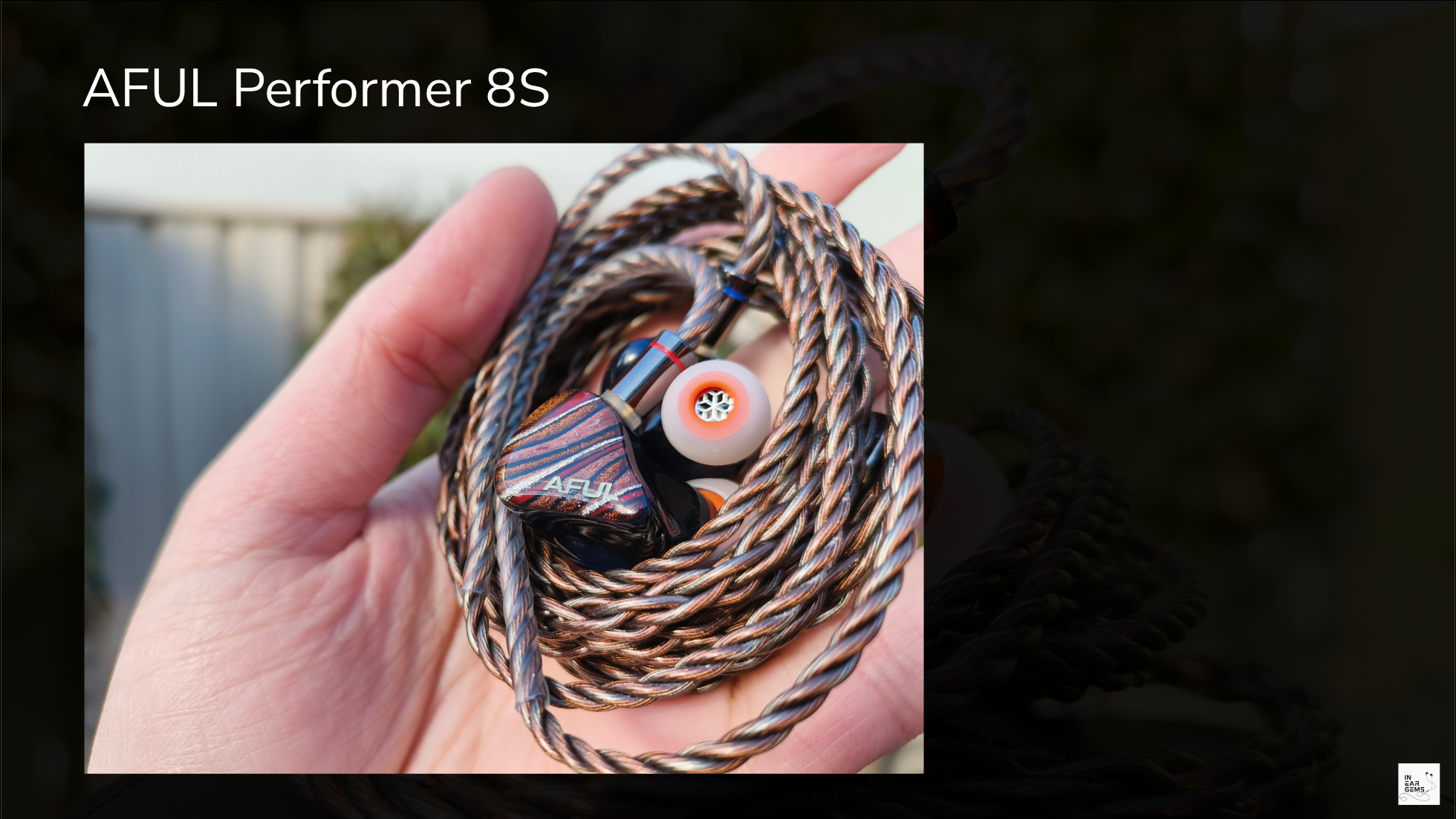
Against the gate IEMs, the Performer 8S lands in the same band as the CFA Andromeda 2020, a small step above it in raw resolution, with a clear edge over the Moondrop Blessing 2. Against the AFUL Cantor, Cantor still surfaces more nuances and details when tonal differences are set aside, and the gap widens with each swap. The Performer 8S is quite close to Cantor, but not yet in its band.
I would place the Performer 8S at 4.5/5 on resolution.
Soundstage & Imaging
The Performer 8S does three-dimensional positioning well. Instruments sit at distinct left-to-right positions and at distinct depths, with some elements floating clearly above the head in dense mixes. The presentation feels like an immersive bubble around the head rather than a flat plane across the ears. The bubble wraps closely around the head rather than projecting all the way into the room (a rare trick for any IEM or headphone), but the positioning of instruments within that bubble is precise and three-dimensional.
On Original Sound Effect Track - Memory from Gundam Seed Destiny OST album, the instrumental elements sit far back, feeling like they come from outside the head on the front left and front right, while the sound effect stays in the middle, slightly at the front of my head. There is a clear bubble of sound all around my head, not speaker-like, but immersive.
On Shadow of Baar Dau, the vocal chants feel realistically distant, more in front of the face than inside my head. A spacious rendition, which is what this background track expects.
The IEM translates well to games. On recordings of CS:GO gameplay, distant gunshots and explosions carry a convincing sense of distance and location, with forward positioning good but not at the level of a two-speaker setup.
The Performer 8S sits in the same band as the AFUL Cantor on this dimension.
Bass Performance
The Performer 8S handles bass and dynamic with authority. Crescendos are communicated with grin-inducing impact, and every beat carries grippy texture and rumble without smearing. The bass does not skimp on the energy at the top of the note or the decay on the way down. Across busy passages, the IEM holds up well, with the only softness showing up in the very loudest, most cluttered moments.
On A Reckoning in Blood from The Ghost of Tsushima OST, the crescendo at 01:10 lands with the kind of impact that makes me grin and feel my blood pumping when it drops. Every beat has excellent control on the attack side without skimping on the energy or decay.
On Strength of a Thousand Men (Live) by Two Steps from Hell, the bass line at the beginning has a clear rumble, and the bass notes carry a clear sense of texture, feeling grippy. The IEM shows excellent control here. The kick drums on Playing God by Polyphia are impactful, with clean attacks and authoritative physical punch at the top of the note. The bass guitar has good but not overbearing presence, with details audible on attention rather than a low-pitched hum.
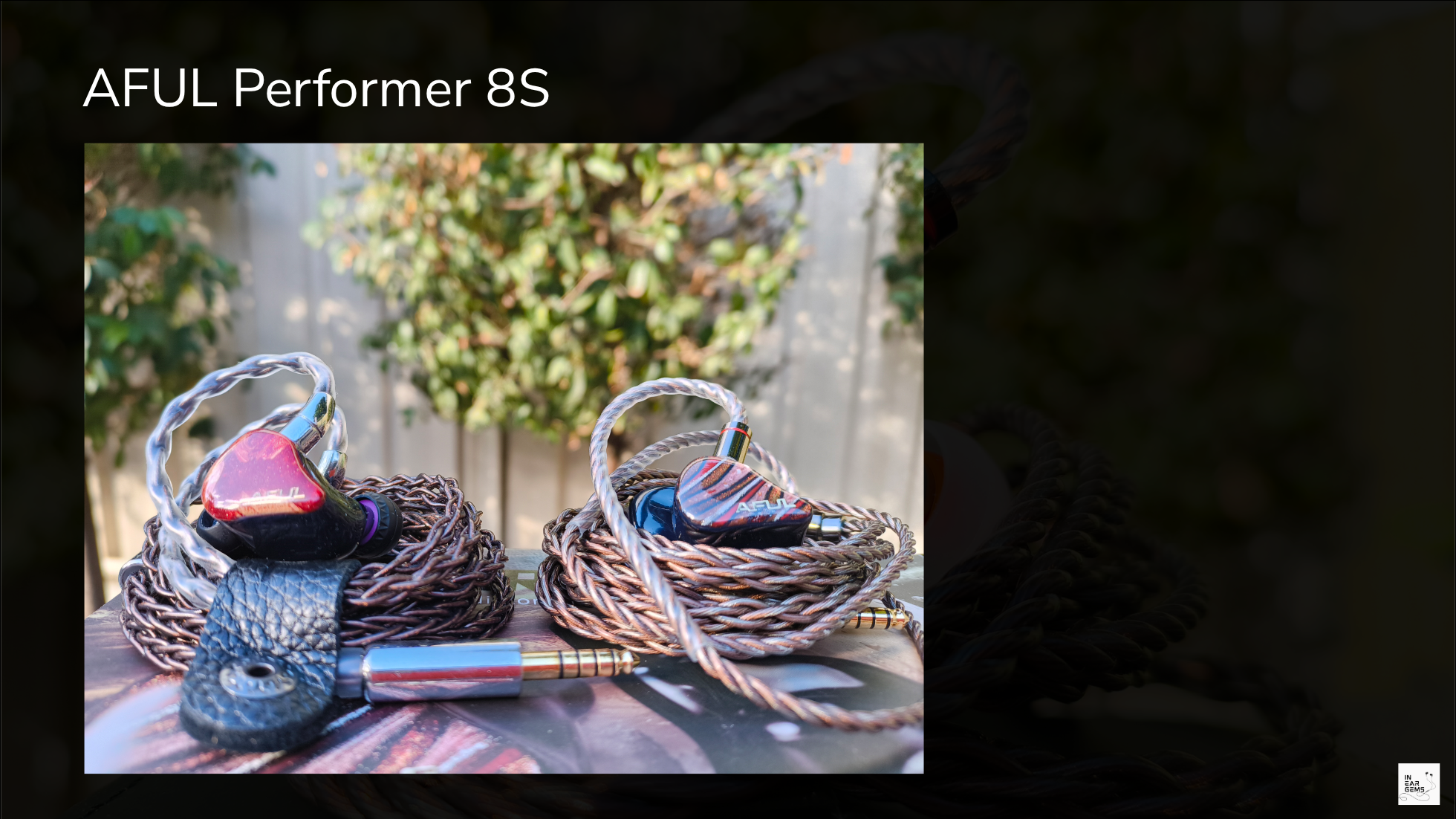
It is worth noting that this is not a bass-head IEM. It takes whatever bass is in the track and reproduces it well. It does not make bass the dominant part of the track.
The Performer 8S makes the music want to move. Tracks with strong rhythms land with a clear sense of drive and momentum. Toe-tapping, in other words.
I would place the Performer 8S at 5/5 on bass and dynamic.
Selected Comparisons
Vs AFUL Cantor
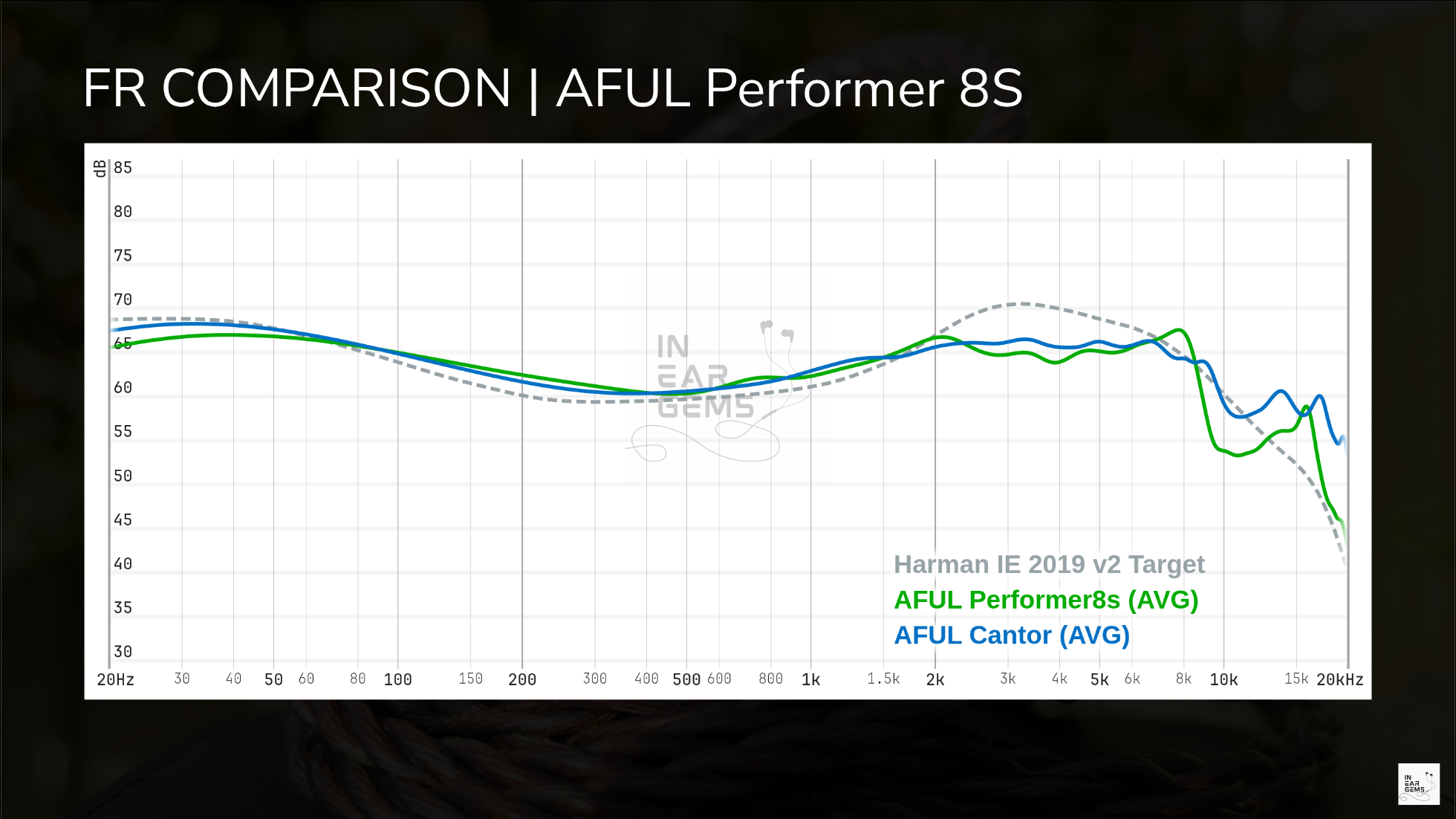
The Cantor is the same house but a meaningfully different tuning. Where the Performer 8S is warm, with a slightly recessed upper midrange and a bass-forward lean, the Cantor is leaner and more neutral, which makes its details easier to surface by default. In raw resolution, Cantor still pulls more nuances and details when tonal differences are set aside, and the gap widens with each swap. The Performer 8S is close to Cantor in resolution but not yet in its band.
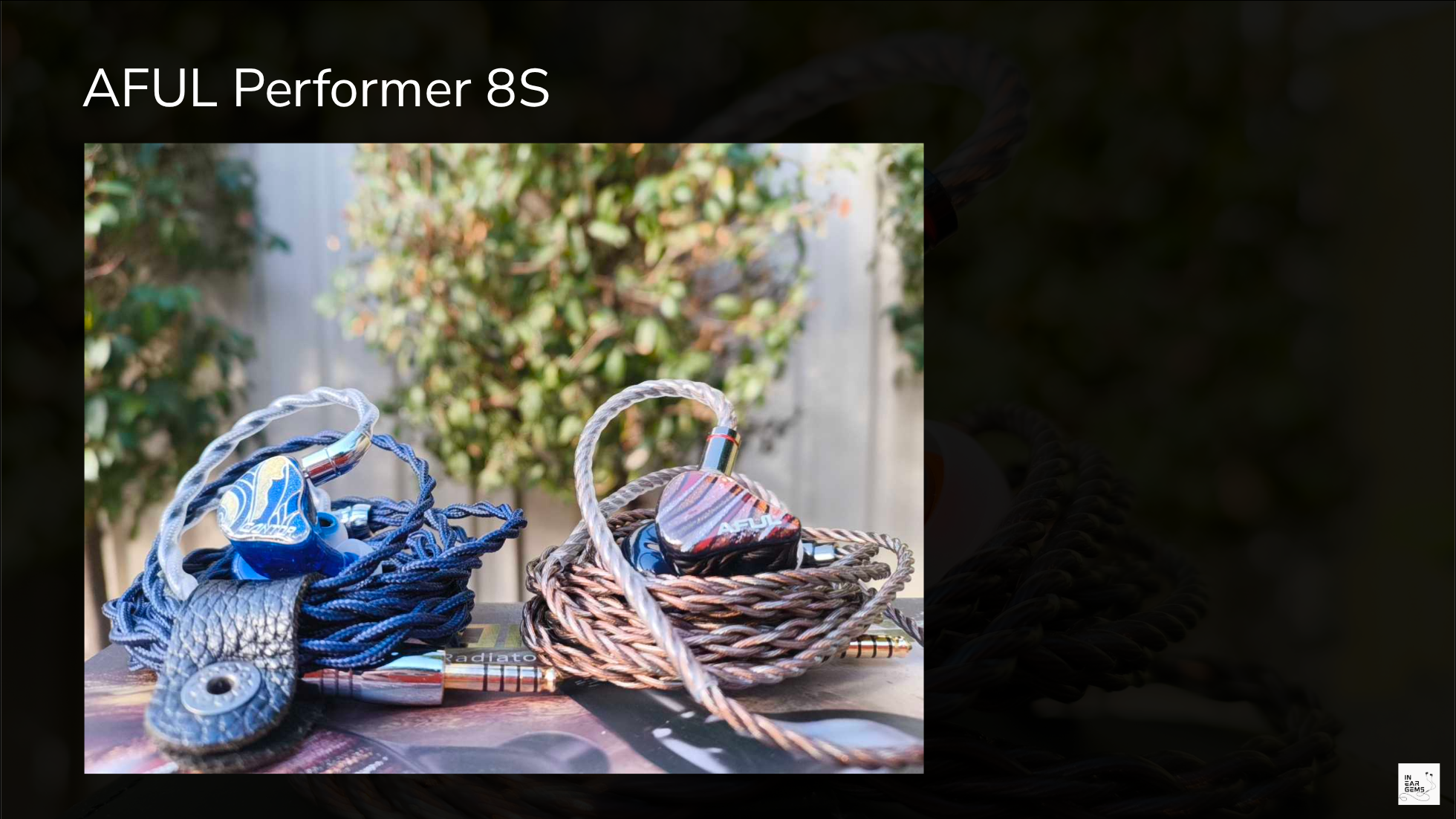
On soundstage and imaging, however, the two sit in the same band. Both do three-dimensional positioning inside a tight, immersive bubble around the head. The Cantor’s leaner tone might give the impression of more space because cymbals and air are more forward, but the underlying imaging capability is similar.
The Cantor is the IEM for listeners who want a neutral AFUL house sound with technical performance at the top of the brand’s range. The Performer 8S is the IEM for listeners who want a slightly warmer, more musical ride that still climbs high enough to challenge the Cantor on imaging and come close on resolution. They are siblings, not rivals.
Vs AFUL Performer 8 (the original)
The Performer 8S is the follow-up to the original Performer 8, and they sound meaningfully different. The original Performer 8 is crisp, clean, flat, and precise. The Performer 8S is tuned for warmth, with body, bass, and a cozier overall presentation.
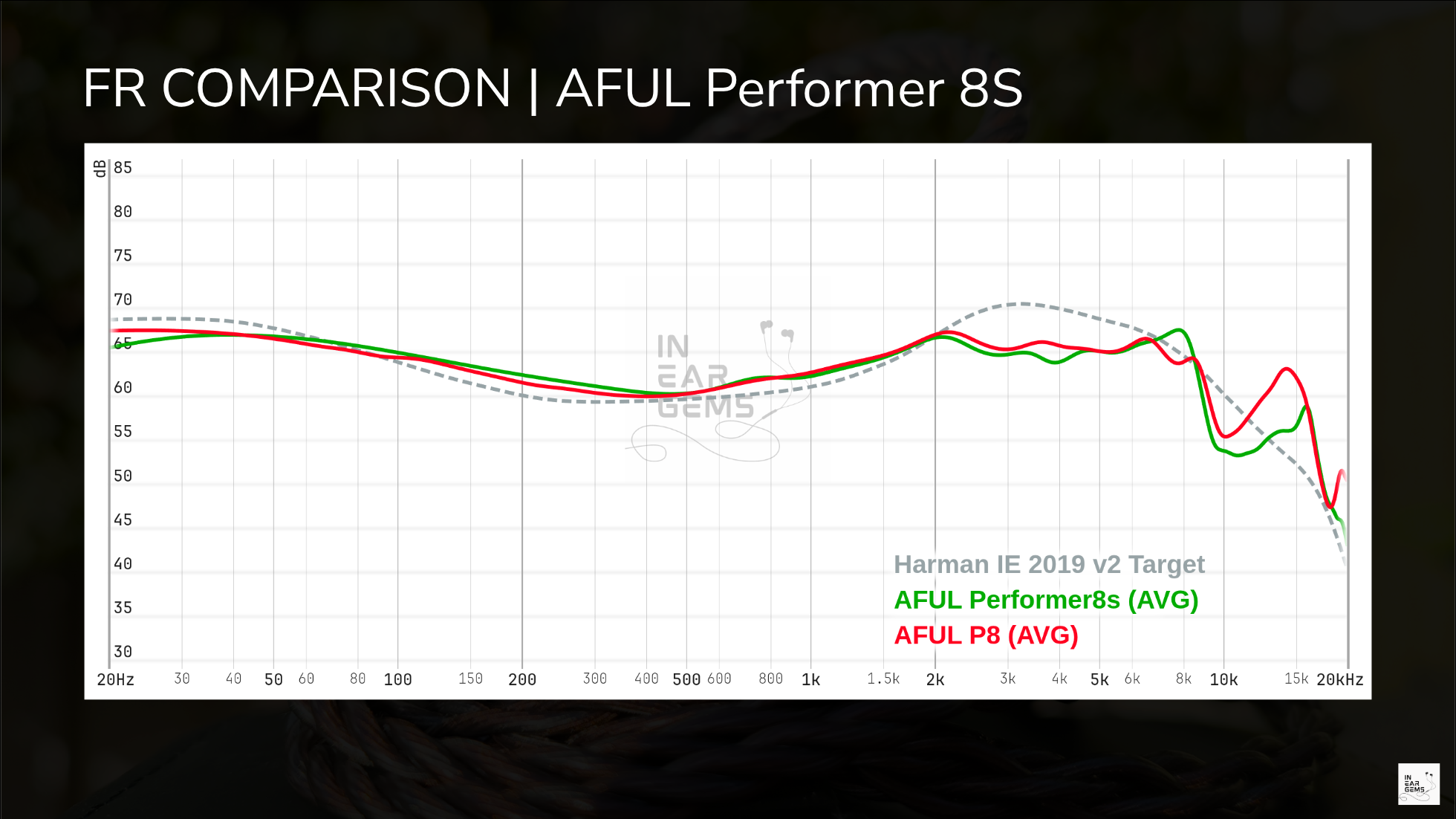
The technical performance of the Performer 8S is also a clear step forward. The original Performer 8 was detailed but flat, not punchy or dynamic enough, and its soundstage was rather flat, though precise. The Performer 8S pushes bass quality, dynamic, and stereo imaging forward without losing the resolution that made the original Performer 8 a breakthrough IEM when it launched.
If you are coming from the original Performer 8 expecting the same IEM but better, you will likely be disappointed by the change. The Performer 8S is a different IEM, not a refined version of the same one. For an upgrade in the same house style (crisp, clean, flat, precise), the AFUL Cantor remains the true upgrade path.
Conclusions
The original Performer 8 was the IEM that put AFUL on my radar because it was the first mid-fi IEM to convincingly land in my 4/5 band on resolution. That was a big deal, since most mid-fi IEMs back then, even the $600 to $700 ones, barely cleared my 3/5 on resolution. However, the original Performer 8 was also flawed on the dynamic and bass front. Its soundstage was rather flat too, though precise enough.
The industry, filled with skillful and enthusiastic engineers, of course did not stand still. By 2025, the IEM market had jumped significantly to the point that the level of detail of the original Performer 8 is no longer a wow factor but somewhat an expectation. So I was curious, and a bit concerned, about how AFUL would follow up. The Performer 8S answers that question.
It is both great and not great for some listeners. The great thing is that AFUL pushed the technical performance forward without losing the resolution, which was the original Performer 8’s defining trait. The not-great thing is that the Performer 8S is a different IEM from the original. The original is crisp, clean, flat, and precise. The Performer 8S is tuned for warmth, with body, bass, and a cozier overall presentation. If a listener is expecting the same IEM but better, they could be severely disappointed.
There are also some other concerns worth noting. The midrange is warmer than usual, which could lead to a muffled sensation on a few tracks. AFUL has a particular way of tuning the midrange that pushes the region around 800 to 1250 Hz earlier than other IEMs, so the first moment with an AFUL IEM could be somewhat strange if you are coming fresh from a usual IEM with later ear-gain compensation tuning. Despite my praise for the bass, this is not a bass-head IEM. It just takes whatever bass there is in the track, pushes it a little, and reproduces it well. It does not make bass the dominant part of the track.
Still, I would recommend this IEM as a jack-of-all-trades, everyday-carry, “nice” IEM in your collection. If we put aside the competition right now for a moment, I would say, on its own, the Performer 8S is as good as if not better than quite a few kilobuck-class IEMs that I previously tried, or even wanted to buy. However, it is no longer 2023. The Performer 8S, whilst excellent, is more in line with what I expect from a competent mid-fi IEM in 2026. AFUL crossed the line to bring a top notch performance to the mid-fi, but so did quite a few others. As a consumer, I guess it is a win for your since you finally have something to carry everyday, and still stand up to critical listening like a properly kilobuck-class IEM.
What I like about this IEM:
- Outstanding bass and dynamic performance with grippy texture and authoritative impact
- Three-dimensional soundstage and imaging with precise instrument positioning inside an immersive bubble around the head
- High resolution with all the details that would satisfy careful, deliberate listening
- Slightly warm tuning that gives vocals and strings musical richness without going harsh
- Comfortable for multi-hour sessions with no pressure buildup or pain points
What could be improved:
- The slight warmth softens the cellos tone and reduces the exposed scratchiness of violin in some passages
- Energy level reads slightly muted compared to a strictly neutral IEM on busy orchestral material
- Softness in the loudest, most cluttered moments where elements clump together
- Larger nozzles than AFUL’s older IEMs (Performer 7 and before), with a fit that can be tricky for shallow ear canals with stock tips
Absolute Sonic Quality Rating: 4.5/5 - Great
- Timbre and tonality: 3.5/5 - Good
- Bass and dynamic: 5/5 - Outstanding
- Resolution: 4.5/5 - Great
- Soundstage and imaging: 5/5 - Outstanding
Bias Score: 4.5/5 - I like this IEM