Juzear Harrier - The Caged Bird
Can data really guide the creation of an IEM for most listeners? That’s the premise behind the Juzear Harrier, developed with Super* Review using Squiglink’s database of measurements from multiple reviewers. The concept is compelling. But does the execution deliver? Let’s explore.
Forewords
- What I look for in an IEM is immersion. I want to feel the orchestra around my head, track individual instruments, and hear all of their textures and details. I’m not picky about tonality, as long as it does not make the orchestra, violin, cellos, and pianos sound wrong.
- I rate IEMs within with a consistent scale from 1 (Poor) to 3 (Good) to 5 (Outstanding). An overall ranking of 3/5 or above is considered positive.
- Ranking list and measurement database are on my IEM review blog.
- The terminology for subjective impressions in this review is based on the Audio Wheel for reproduced sound defined in the technical report ITU-R BS.2399-0
- This review is based on a review sample from Hifigo (Thank you!). I have no affiliation with or financial interest in Hifigo or Juzear.
- The unit is available on Hifigo Web Store at $299.
General Information
The Harrier is a collaboration between Juzear and the famous audio reviewer Super* Review (Mark Ryan), who runs the Squiglink database. Harrier is the first in the so-called “Tuned with Squiglink” program: “a program developed by Mark Ryan Sallee to help IEM manufacturers create products that sound their best while avoiding common tuning pitfalls. Drawing on over eight years of experience reviewing and measuring more than 500 IEMs, Mark combines careful listening, prototype measurements, expert feedback, and parametric EQ (PEQ) guidance to refine each IEM’s sound. This program isn’t about hitting a specific FR target curve — it’s about tuning IEMs to sound their best for the target customer.”
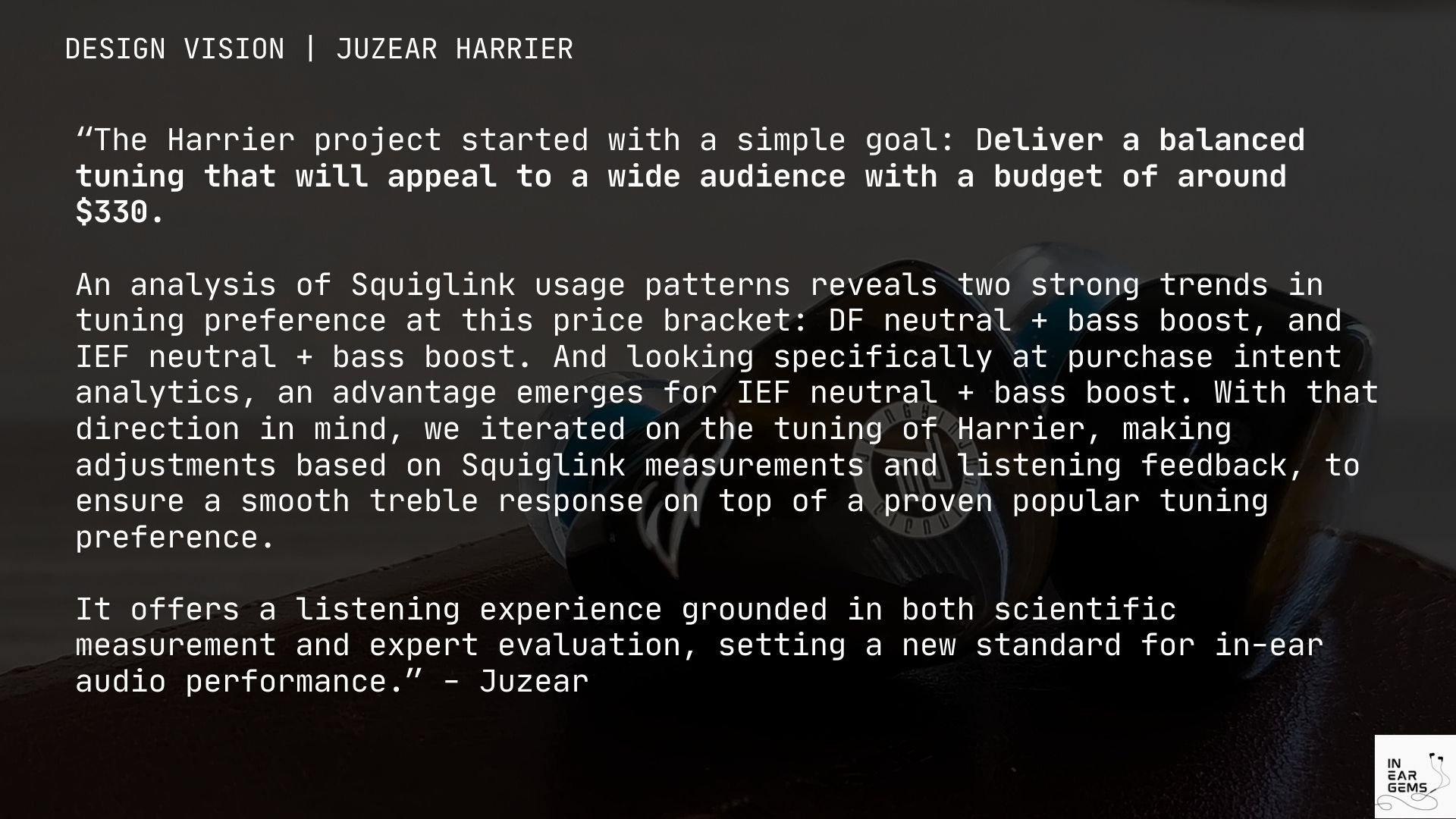
According to the designers of Harrier, this IEM has one goal: “Deliver a balanced tuning that will appeal to a wide audience with a budget of around $330. An analysis of Squiglink usage patterns reveals two strong trends in tuning preference at this price bracket: DF neutral + bass boost, and IEF neutral + bass boost. And looking specifically at purchase intent analytics, an advantage emerges for IEF neutral + bass boost. With that direction in mind, we iterated on the tuning of Harrier, making adjustments based on Squiglink measurements and listening feedback, to ensure a smooth treble response on top of a proven popular tuning preference.”
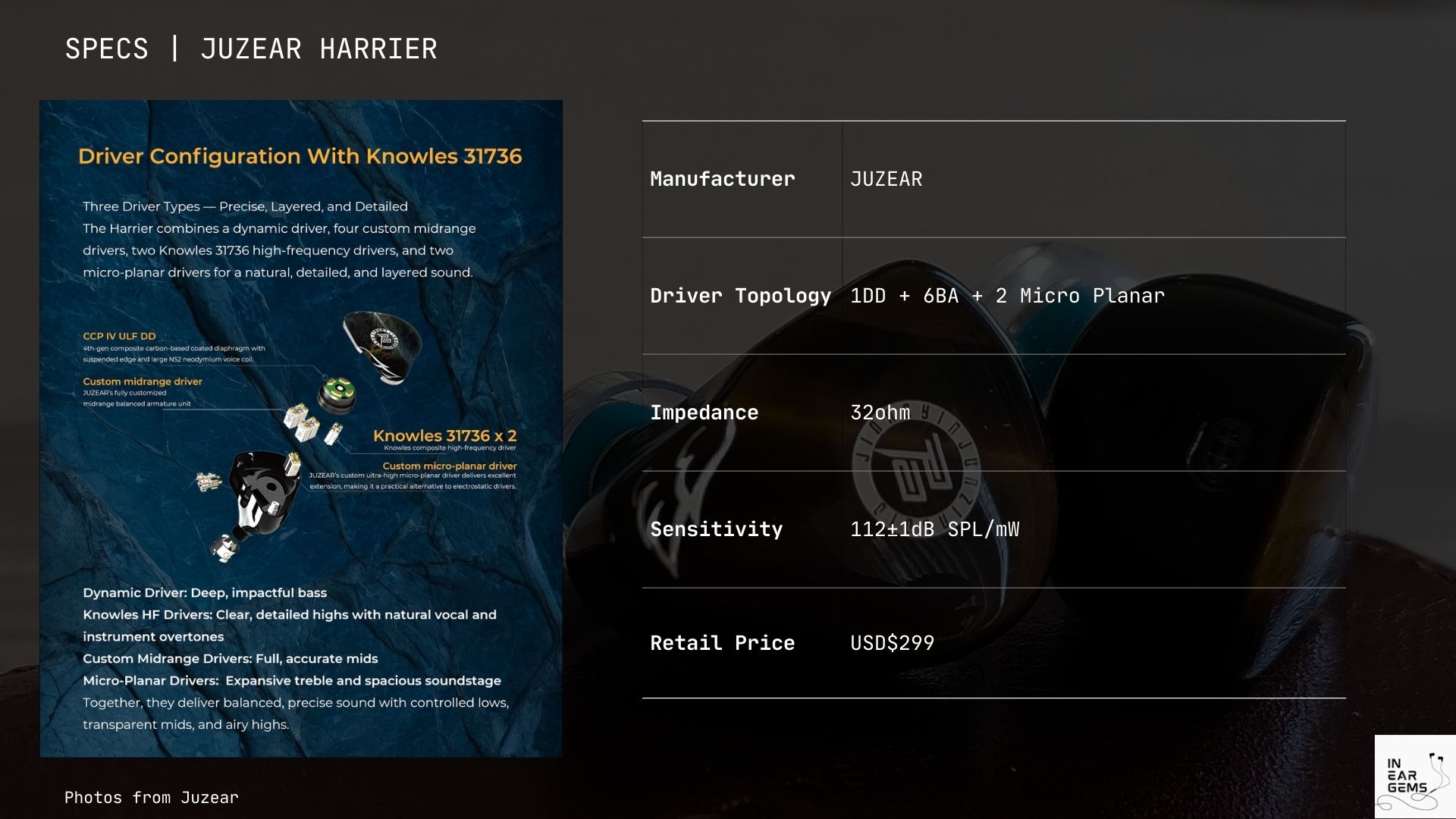
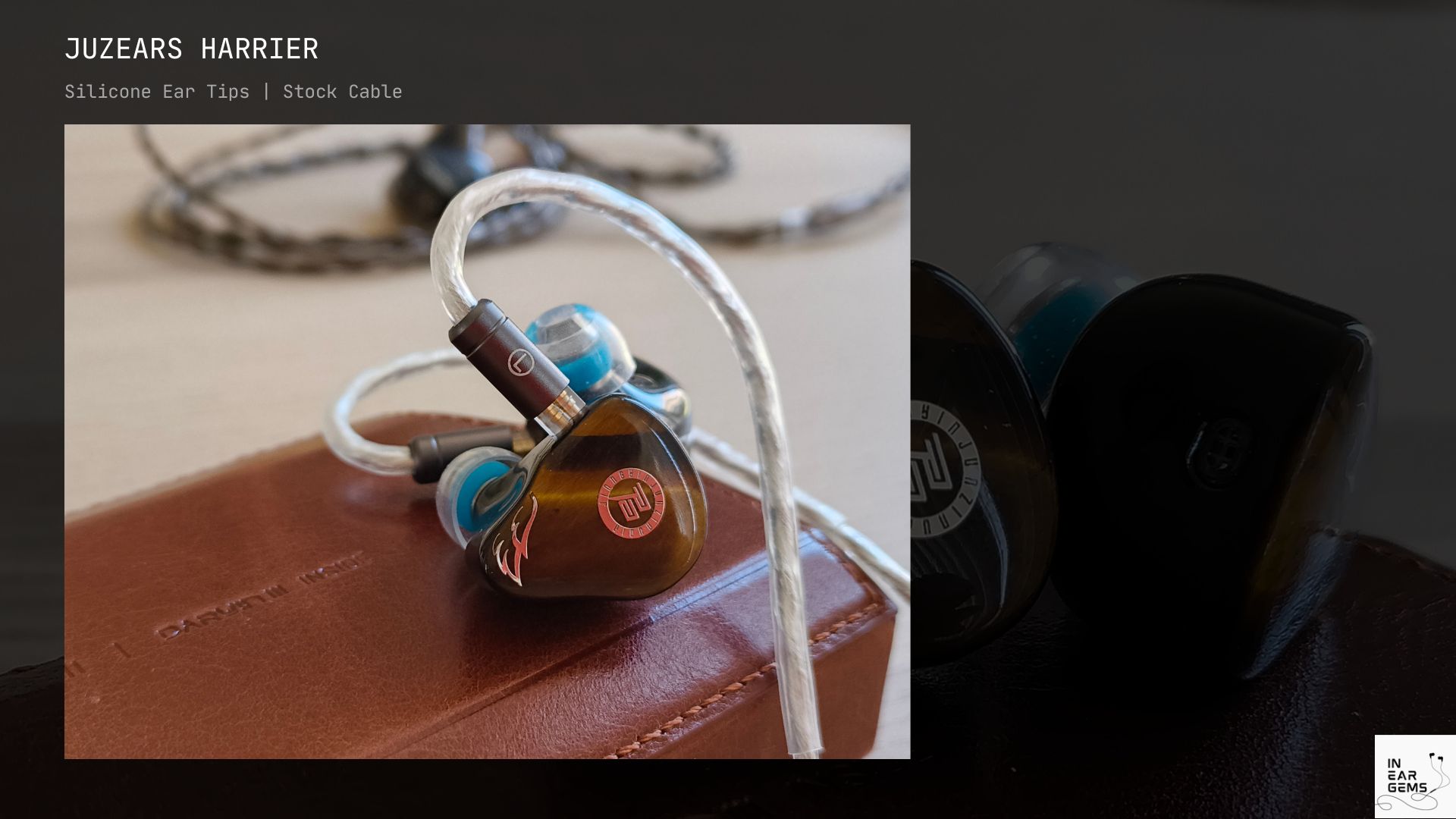
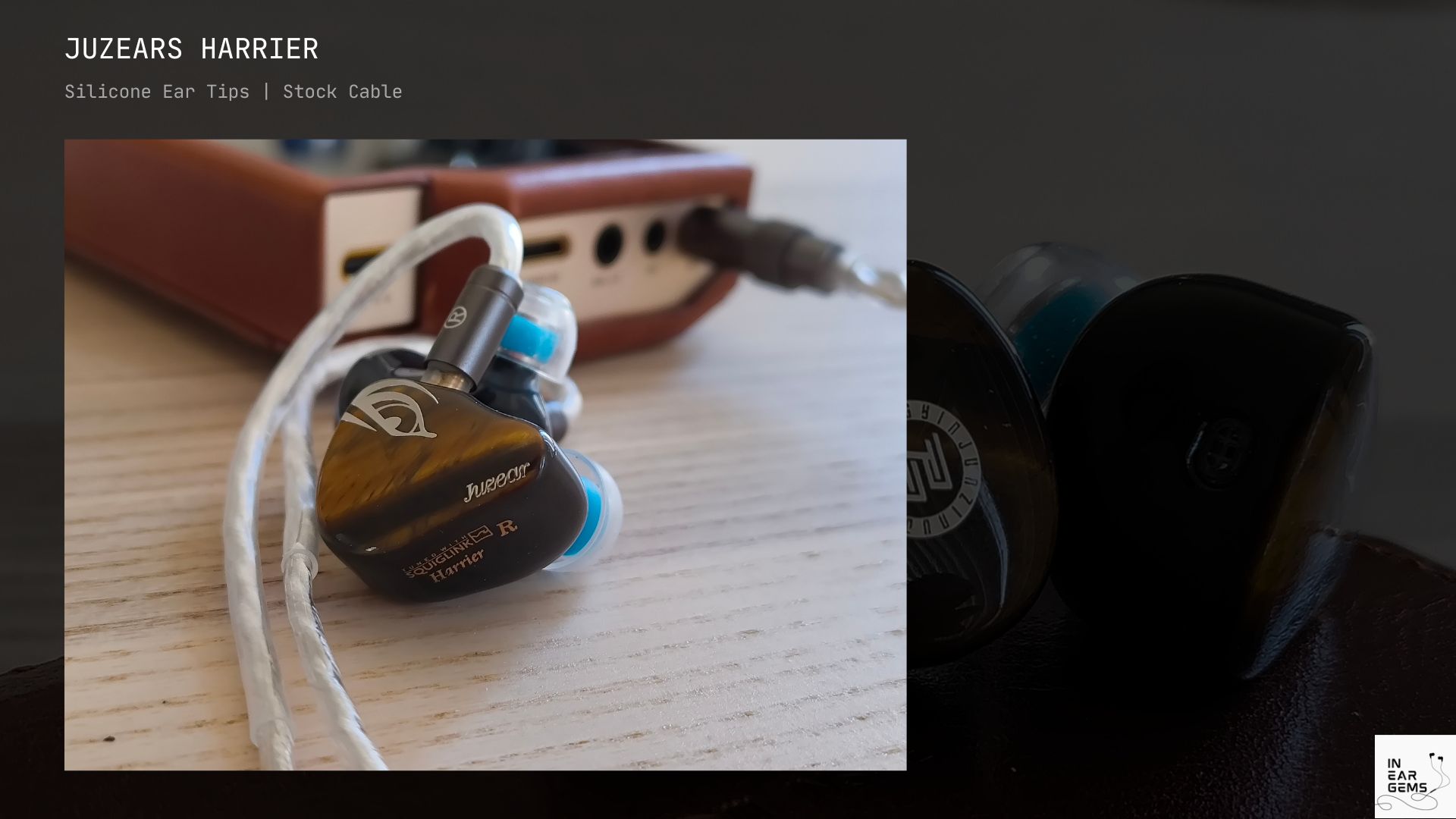
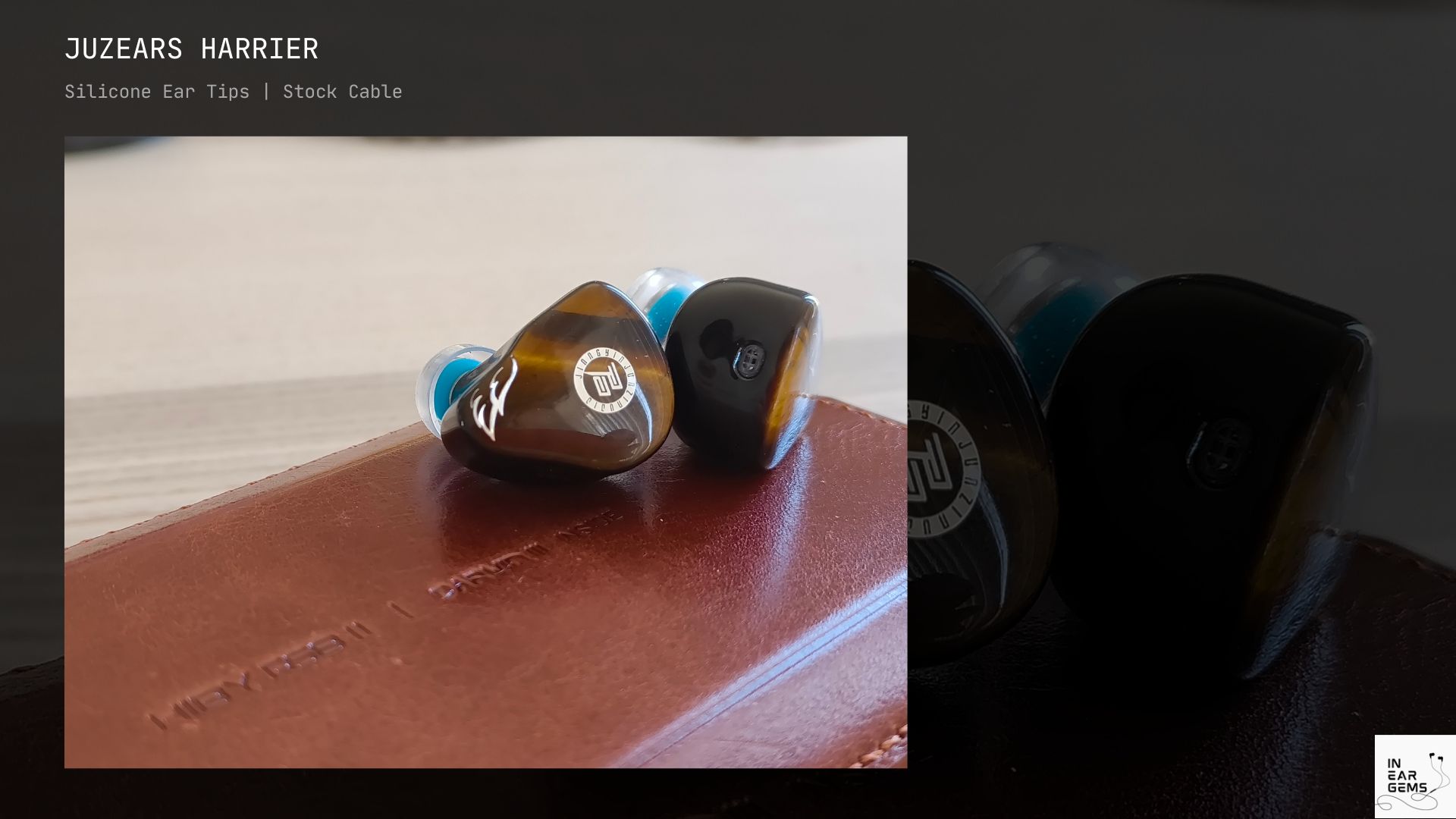
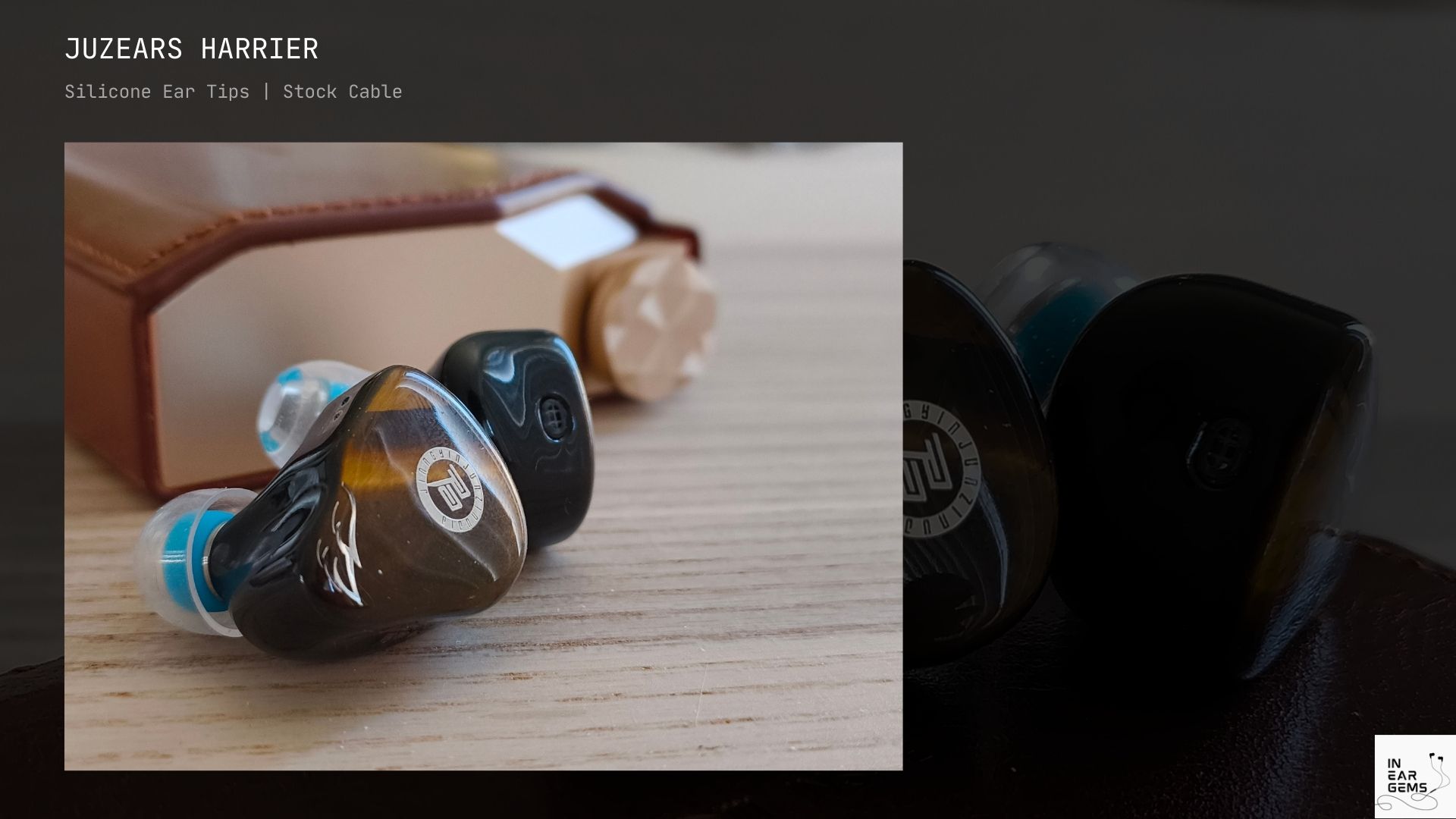
The Harrier features a driver configuration of 1DD + 6BA + 2 Micro Planar Drivers, housed in resin shells. With an impedance of 32Ω and sensitivity of 112dB ± 1dB SPL/mW, I found it easy to drive in the sense that it is not too demanding on the amp, nor it is too sensitive to the point of hissing with any source device. The frequency response range covers 20Hz - 20kHz, and THD+N is rated at ≤0.8%. The net weight is 7.1g per side, which feels reasonably lightweight during extended listening sessions. The IEM comes with swappable plugs for both 3.5mm and 4.4mm connections. It utilizes a four-way crossover design to manage the complex driver array.
In the Box
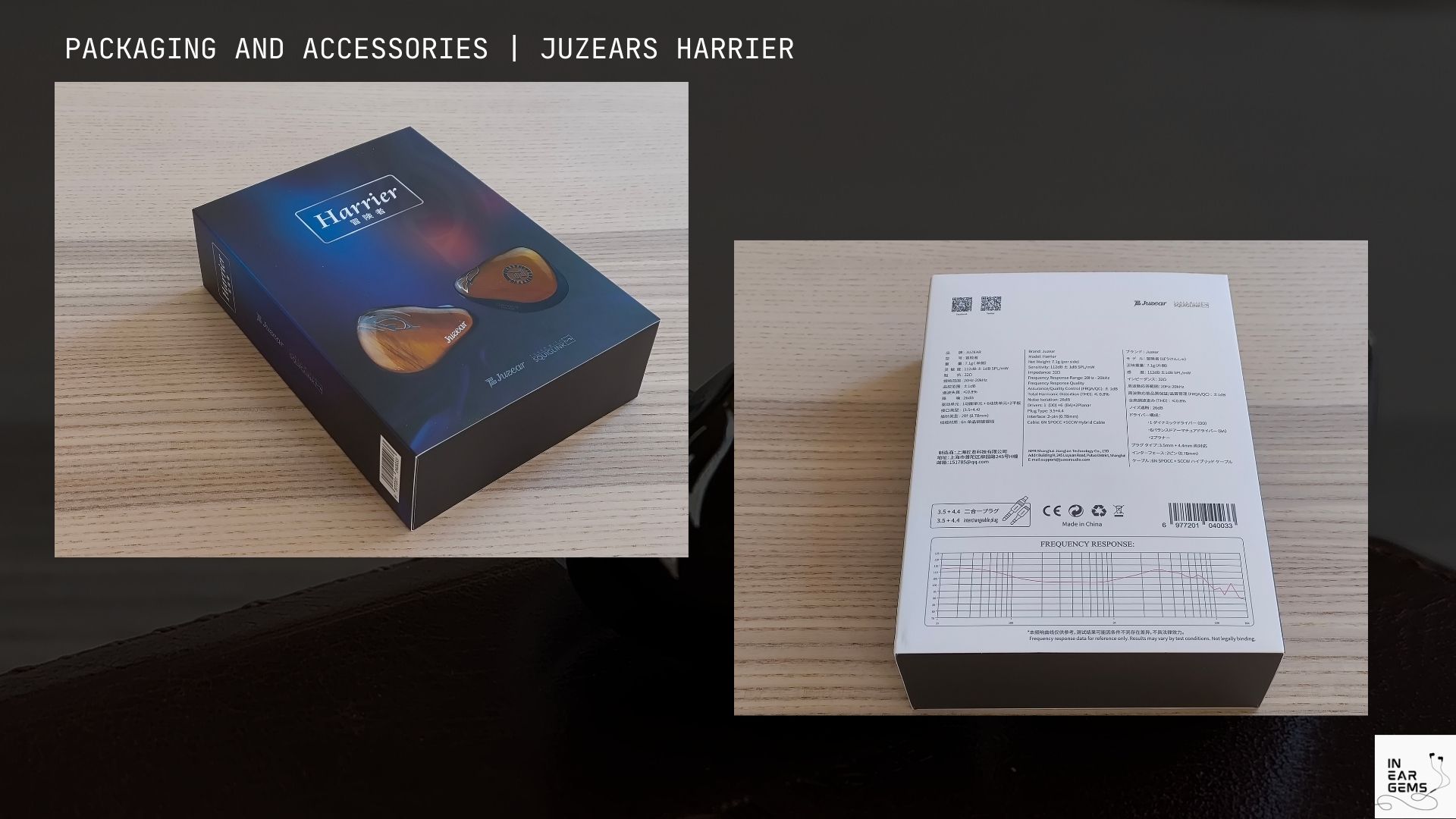
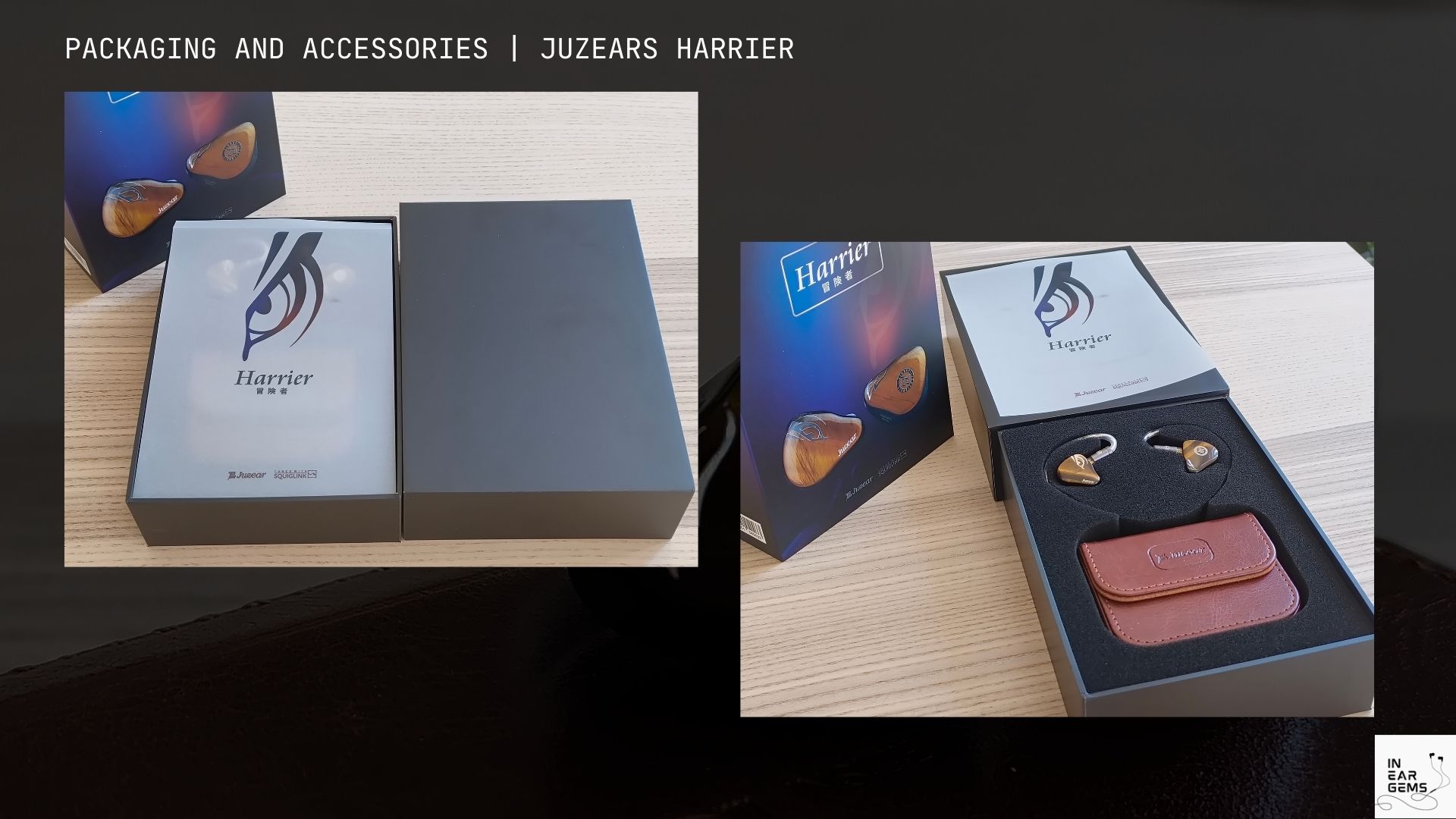
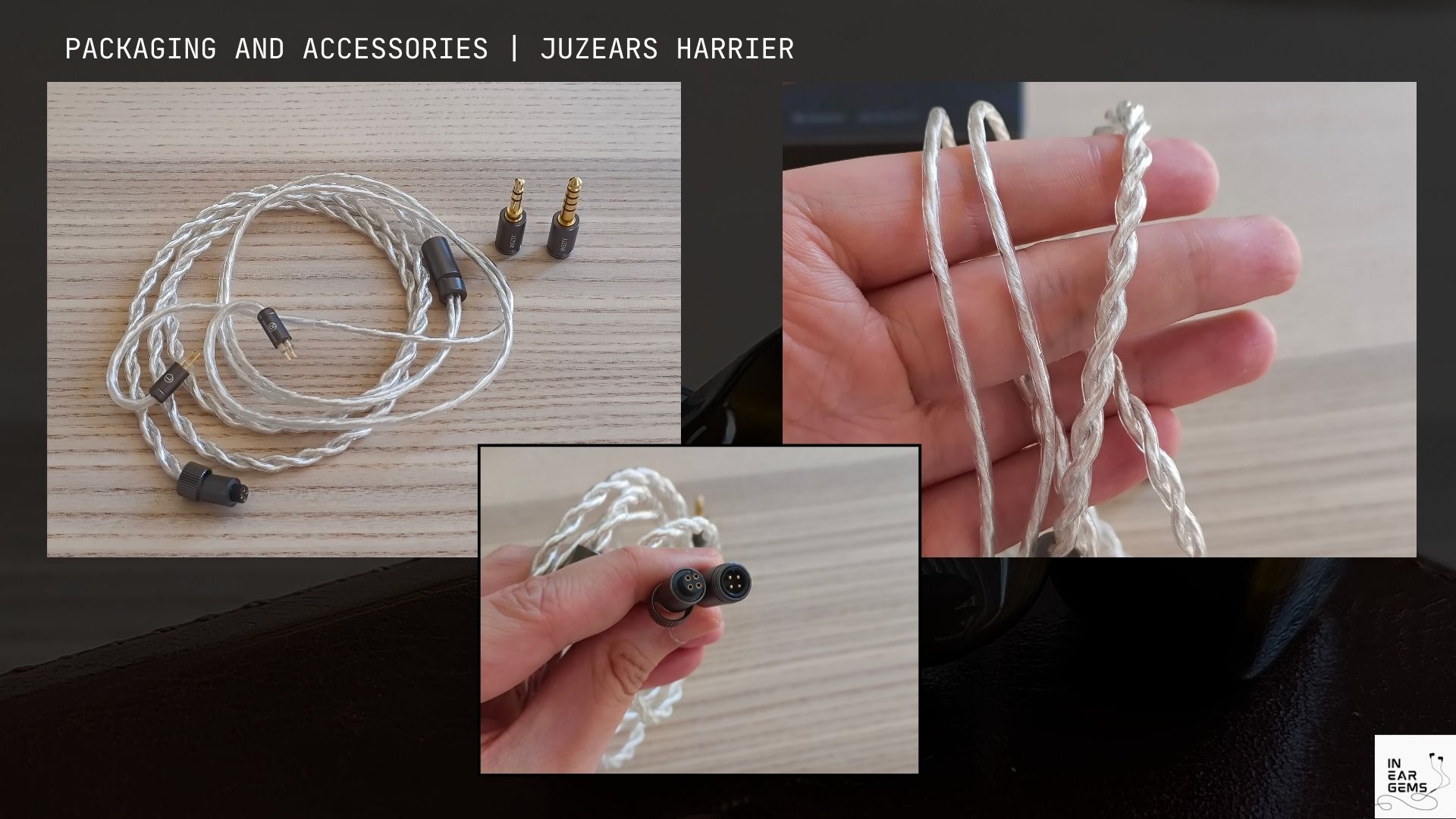
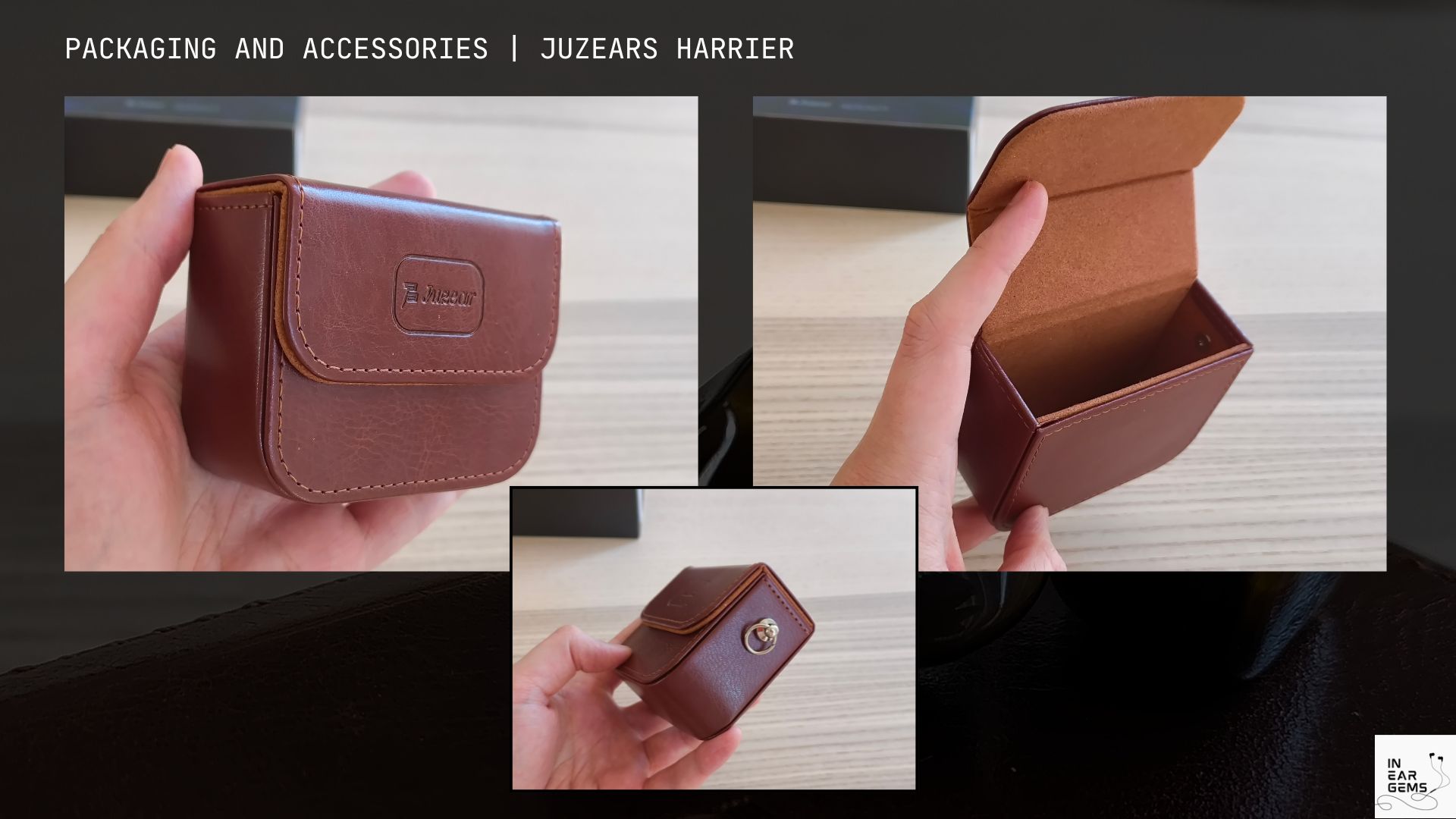
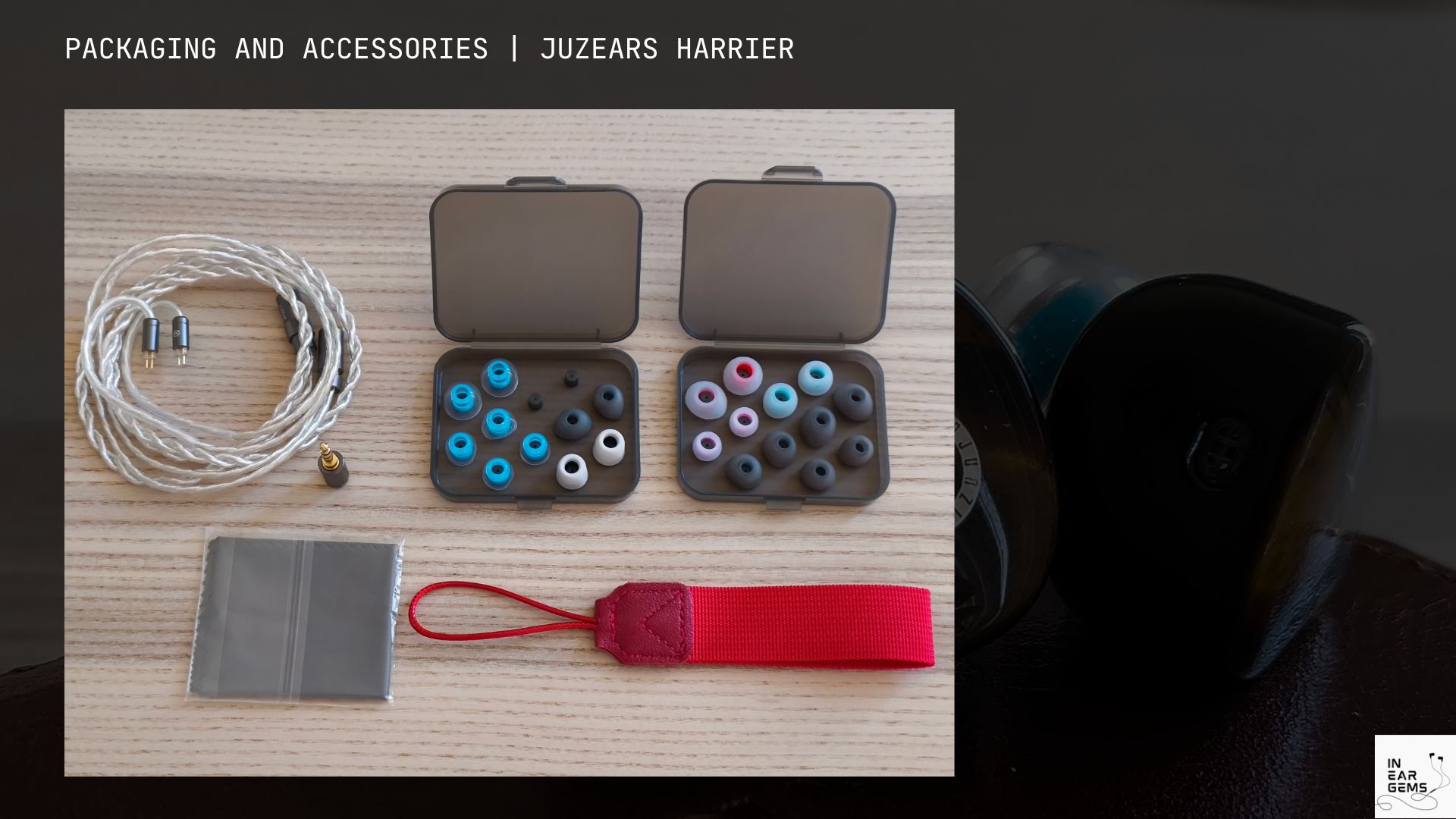
The Juzear Harrier comes with the following accessories:
- Leather case with a red lanyard
- One IEM cable with interchangeable plug (3.5mm and 4.4mm)
- 3 types of silicone ear tips, plus a pair of foam tips, stored in a proper tips carrying case
- One cleaning cloth
- The IEM earpieces themselves
The included leather case is unique, feels good to hold, offers good protection to the IEM, and looks pleasant. It’s the highlight of the accessories pack for me. The variety of included ear tips shows that they considered different user preferences. The tips are stored in a dedicated carrying case, which is practical.
The packaging itself could be better. At first glance, I did not expect the Harrier to be $300. Though, to be fair to Juzear, some even more expensive IEMs from other brands have even more plain packaging. Despite the more basic packaging, the included accessories are of good quality.
Experience
Physical Handling
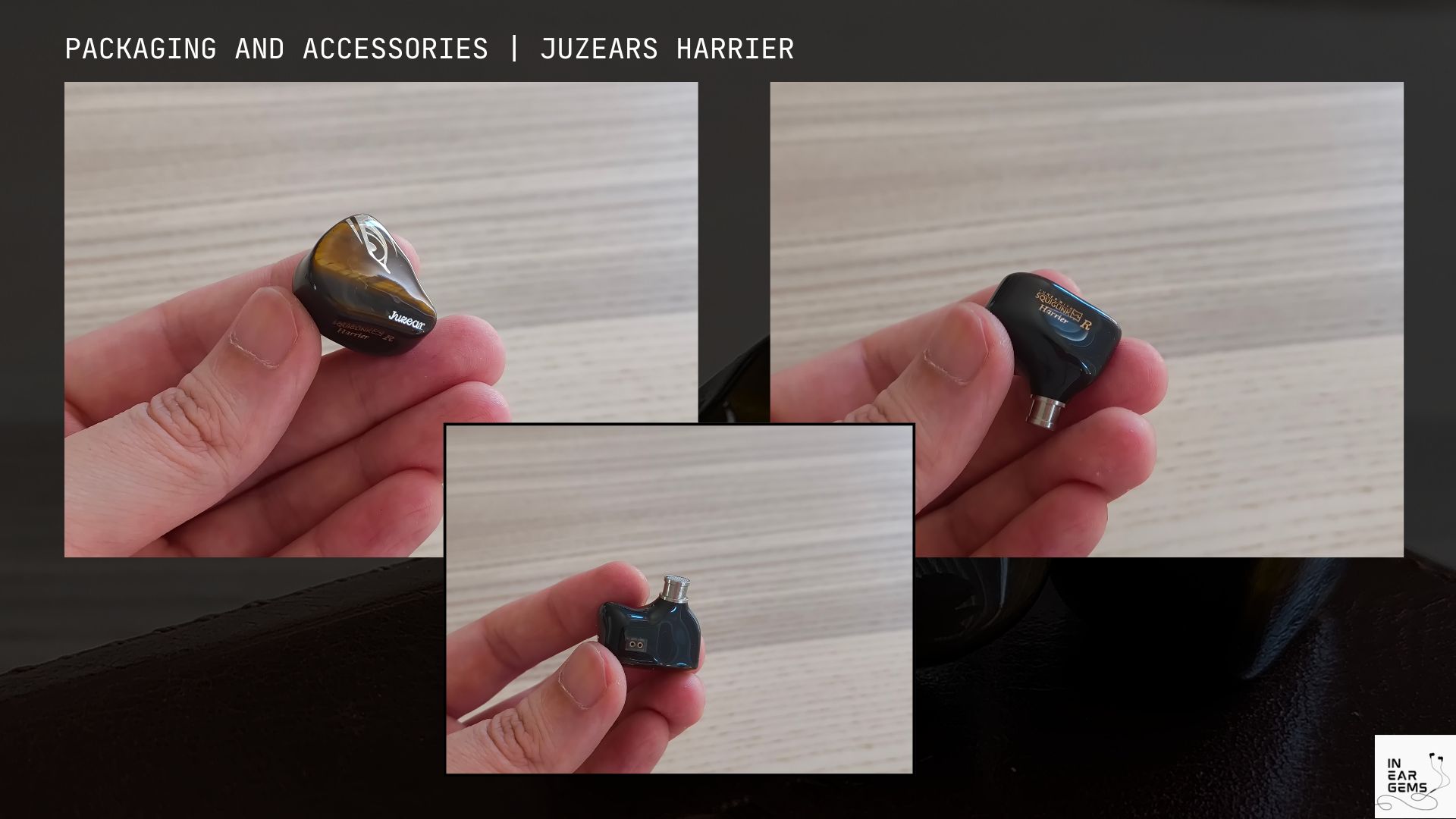
The Harrier is average in terms of comfort. During long sessions with the stock silicone ear tips, I experienced no immediate ear fatigue that would require taking a break, though I did feel some pressure on the inner ears after removing the IEMs after extended use.
The isolation is surprisingly very good. When sitting in a less noisy place, the isolation is so high that with music on, it’s like I don’t hear the world anymore.
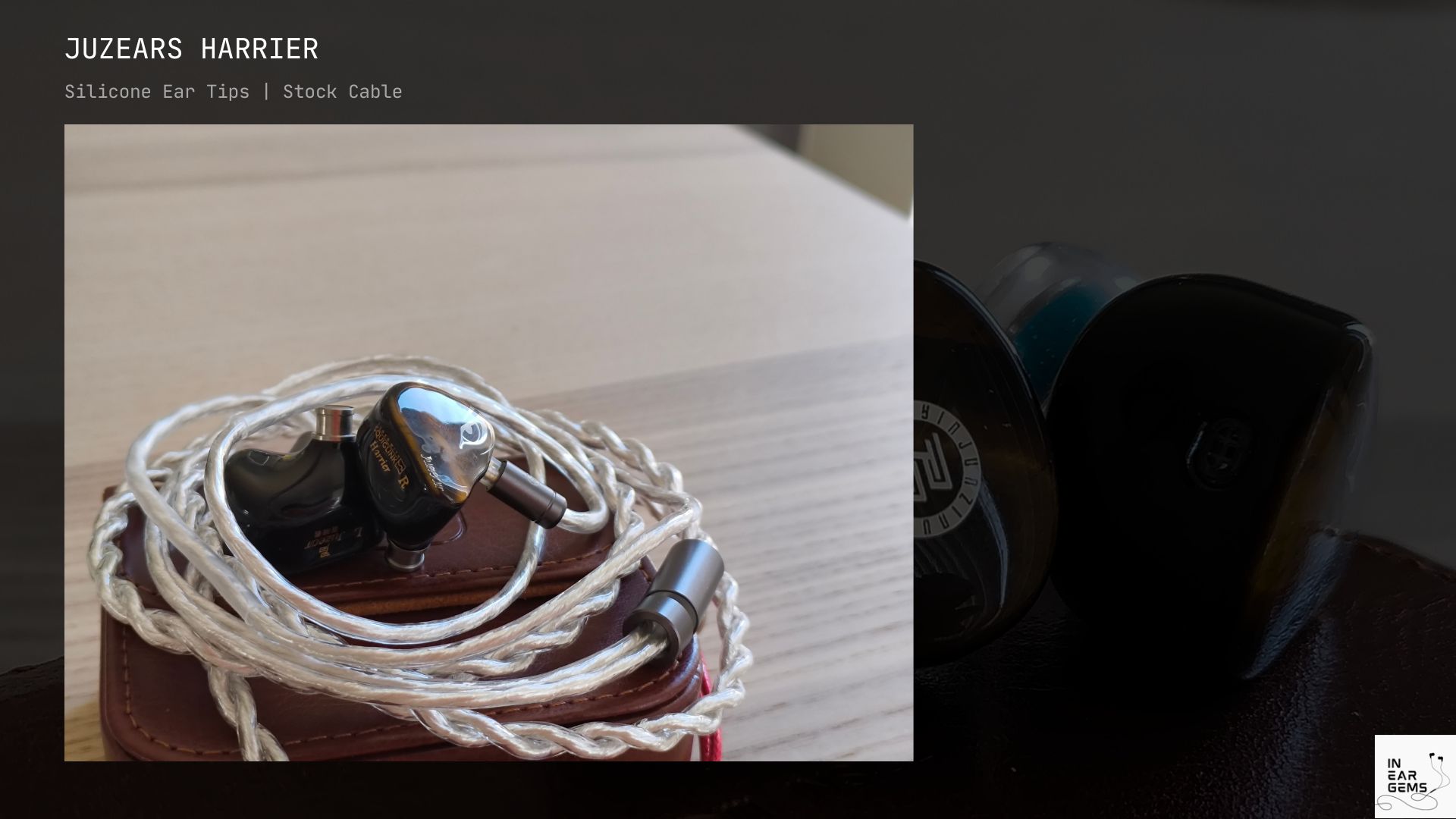
The stubby nozzles of the earpieces might benefit from longer ear tips like Spinfit, which could offer a more secure fit. The included cable is a 2-core design, which I don’t mind, but I think a 4-core cable would have been better. The issue with the 2-core cable is that after the chin splitter, each part of the cable going to the ear piece has only 1 core, leading to more kinks and tangles.
My number one recommendation for ear tips would be pentaconn COREIR brass ear tips. These ear tips have a metal tube inside to lengthen the nozzles and (usually) further emphasize the treble energy. The lengthening of nozzles makes the fit of Harrier more stable in the ears. The added treble also gives the much-needed relief to the subdued signature of Harrier.
Sound Signature & Tonal Balance
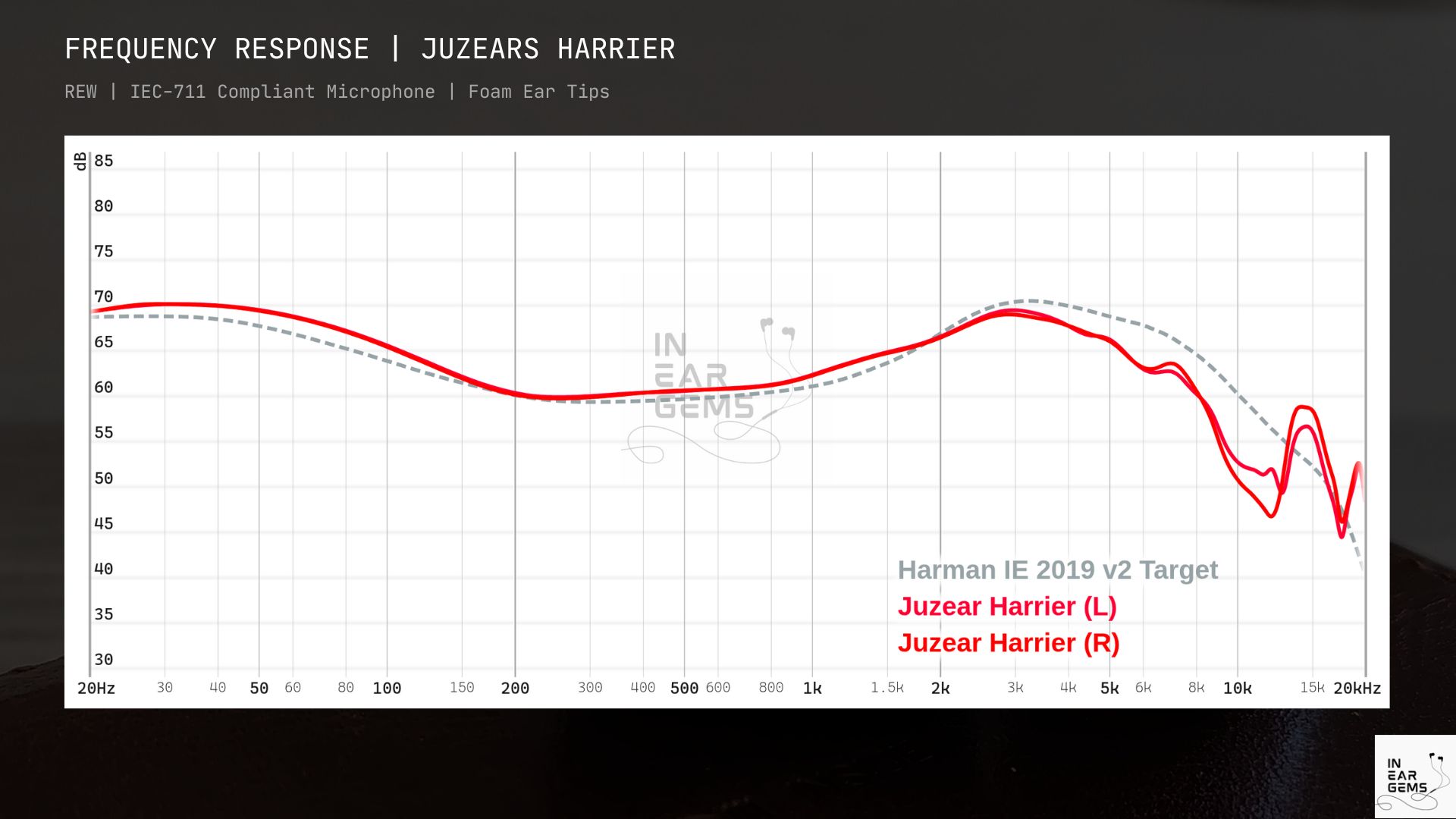

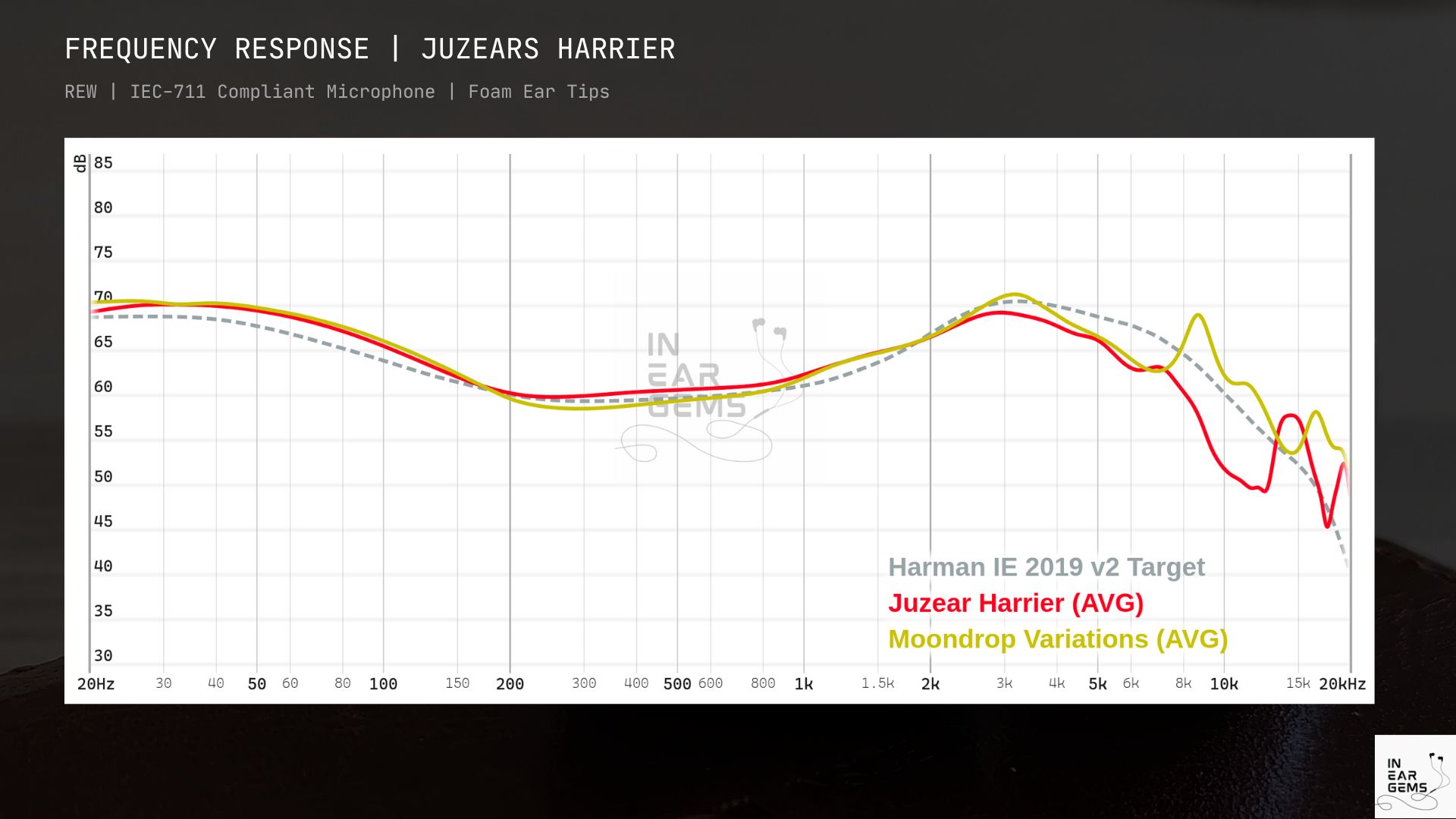
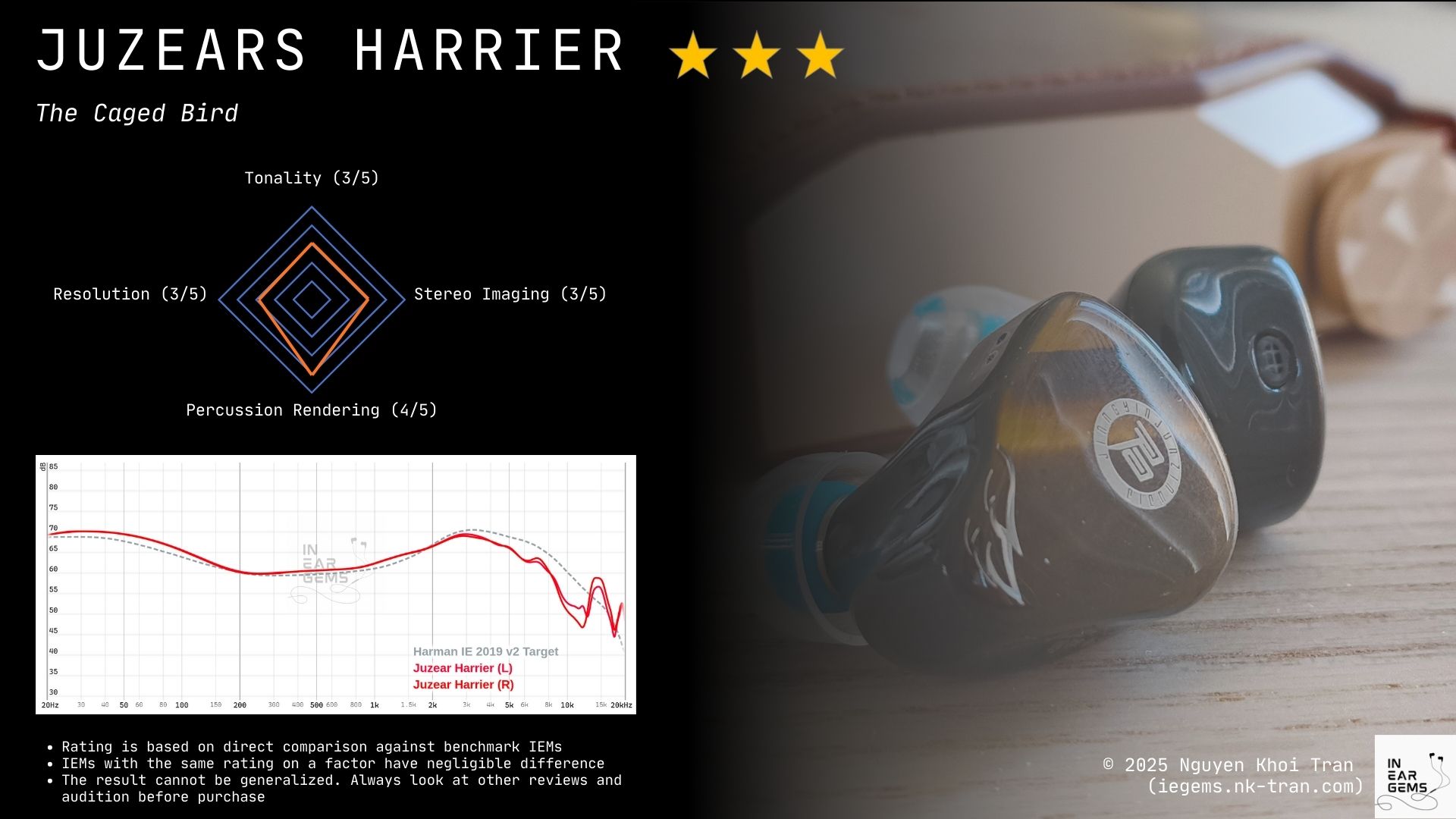
The Harrier presents a neutral with bass boost signature that significantly subdues the treble, making it quite different from other modern IEMs. I found that it has zero harshness or sibilance across recordings, which is excellent for those sensitive to these issues. This is one of the IEM’s strengths, as it can tame potentially harsh recordings without making them sound muted or muffled. For example, with “Shivers” by Ed Sheeran, the IEM shows zero harshness or sibilance across the track, which is impressive given how sibilant this recording can be with other IEMs.
The midrange tuning follows the older Harman IE 2019 and Moondrop VSDF targets with clear emphasis on the upper midrange (around 2.5-3kHz) and a concave slope from around 800Hz, which creates a crystalline, laser-focused character but makes vocals sound slightly hollow. These traits are highlighted with Ed Sheeran’s voice on “Shivers,”. To be sure, I also test with other tracks in the same album and the conclusion remained the same: overemphasized head voice, lacking chest voice, leading to a slightly hollow tone, lacking certain emotive warmth I expected.
With Chiaki Ishikawa’s voice on “Kiwi wa Boku ni Niteiru” by See-Saw, I again find zero harshness or sibilance. The voice sounds bright and clear, but, again, the chest voice is a bit lacking, leading to a slight hollow sensation in the voice.
The bass is well-controlled with good texture, with an emphasis in the subbass region. With “A Reckoning in Blood” from The Ghost of Tsushima OST, I find the subbass (the rumble during and at the end of the note) quite strong and well controlled with good texture. However, the beats from 02:50 are not quite up to my standard. The attack of the drum notes is a bit dull, not emphasized enough. This applies to both the snappy “crack” at the beginning of the note (product of treble) and the initial energy of the note attack (product of 150Hz bass).
The treble is significantly subdued, which eliminates harshness and sibilance but also reduces the sense of air, space, and harmonics that contribute to a more natural presentation. With “Playing God” by Polyphia, cymbals and hats are quite dull and quiet. I have to pay very careful attention to detect these instruments. Because they are too subdued, their nuances and details do not come through clearly either. That said, when I boost the volume to hear these instruments, I find they are quite detailed. The sense of reverberation, resonance, and space of this track is quite lacking compared to my usual experience. With “Bach’s Goldberg Variations” recorded by Lang Lang, the sense of ambience and reverberation built in this track is not fully reproduced by the Harrier IEM. The track feels more “muted” and dampened than my usual experience.
Technical Performance
Resolution
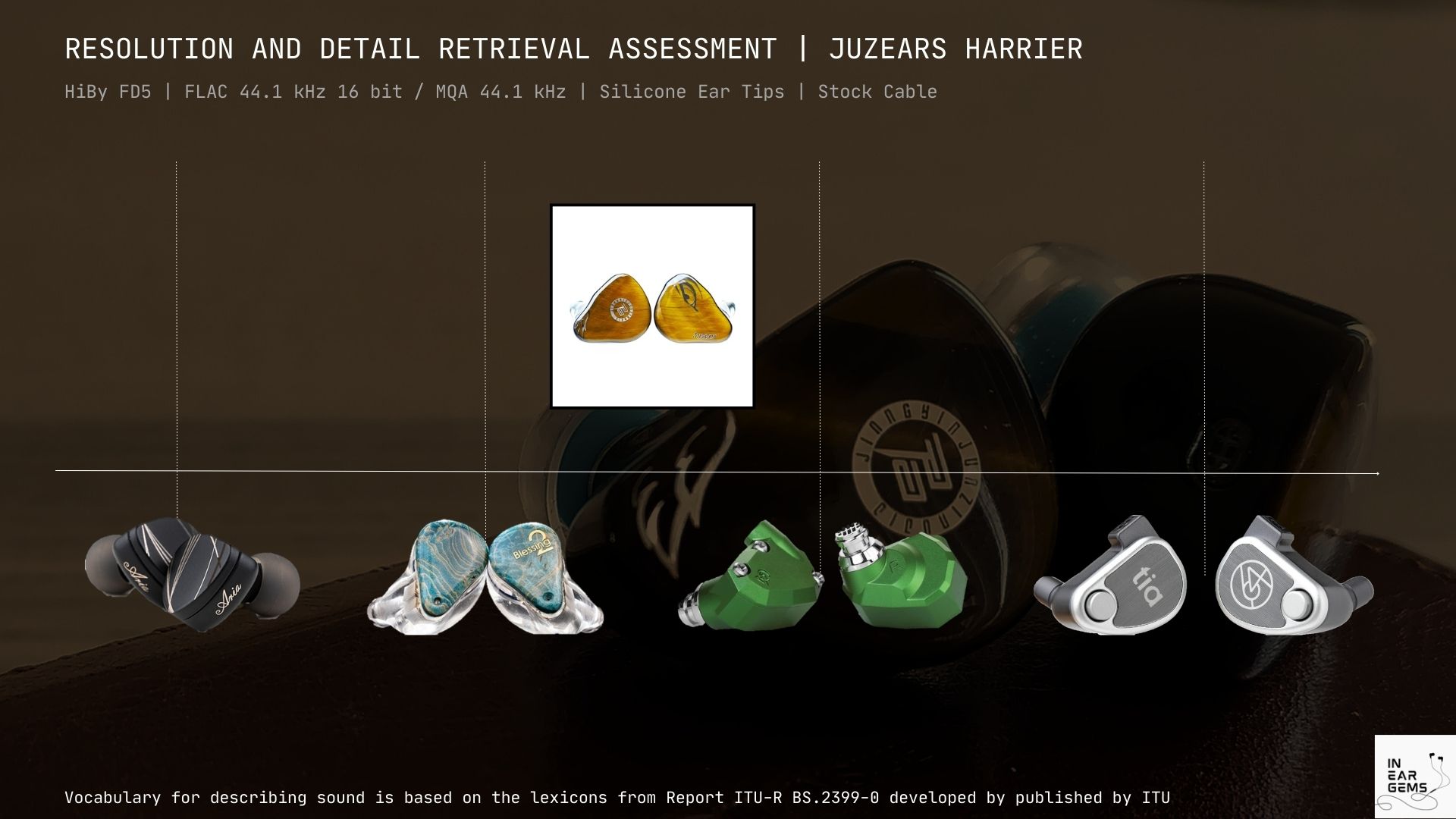
I don’t think the Harrier does a particularly outstanding job when maintaining the separation between instruments in the mix when the music gets complex. With “ABC feat. Sophia Black” by Polyphia, the whole thing becomes more of a chaotic, high-energy blob of sound that would require some effort to separate what from what. In less busy parts of the track, and if I pay enough attention, I can detect and hone into the faint overdub on the side channels. I think all the elements are just a bit too close together, lacking the space or gap between them.
The Harrier performs well with micro-details, particularly highlighting breaths and subtle elements thanks to its upper midrange emphasis. With “Ciaccona from Bach’s Violin Partita No. 2 in D Minor” performed by Kavakos, the micro details, particularly the breath of Kavakos are quite highlighted, almost forced, thanks to the upper midrange emphasis of this Harrier IEM. The reverberation and decays are also quite well controlled and nuanced.
In my A/B tests against benchmark IEMs, I found that the Harrier is very close, if not slightly better than the Moondrop Blessing 2, especially in terms of micro resolution. It’s a bit more nuanced and textured than the Blessing 2. However, it’s quite outclassed by the CFA Andromeda, especially in busy tracks like “ABC feat. Sophia Black” where the track sounds noticeably clearer, with everything more incisive, separated, and easy to follow with the Andromeda vs Harrier.
So, I would rate the Harrier at 3/5 (good) on the resolution front.
Soundstage & Imaging
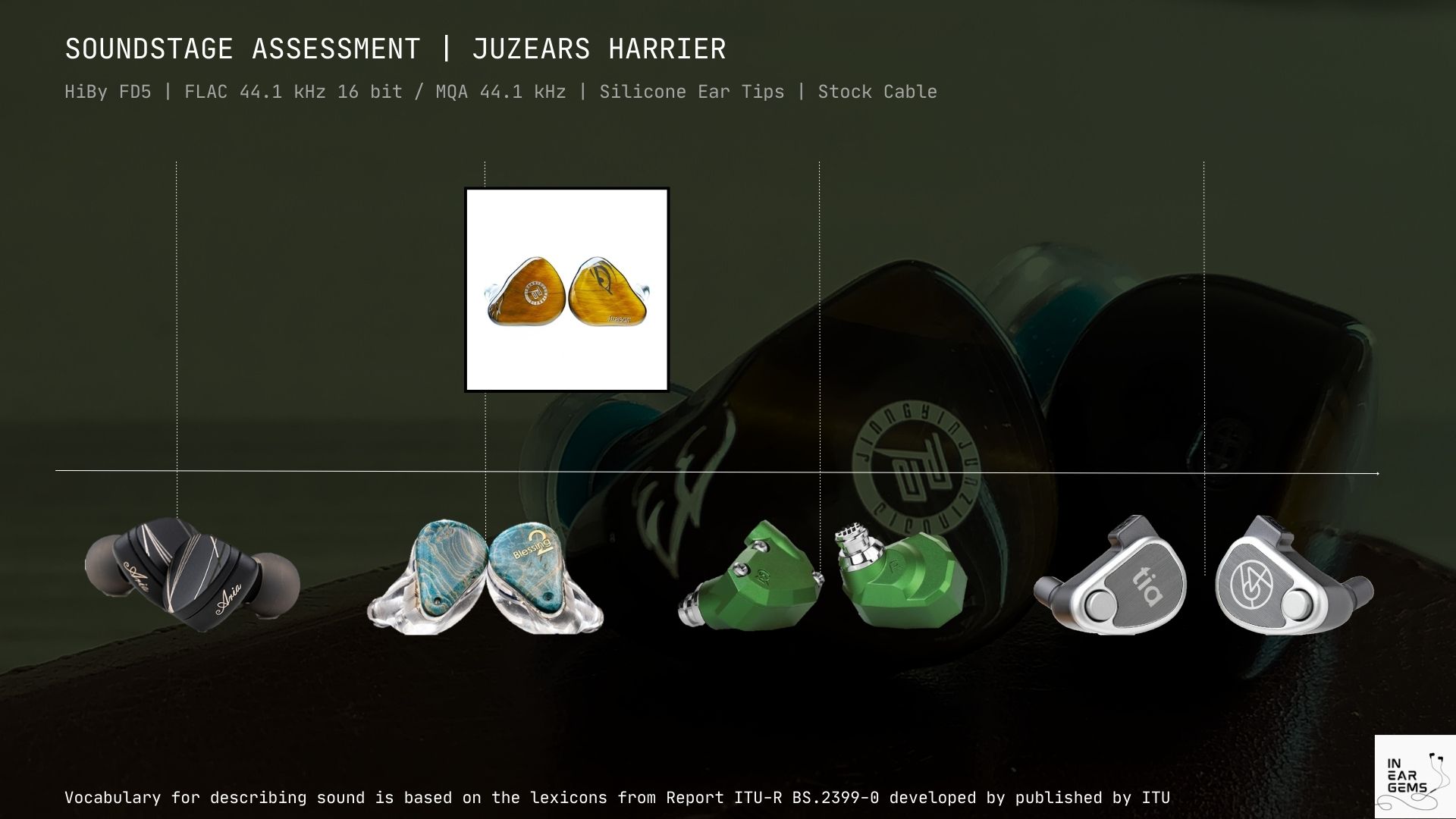
The Harrier offers a decent soundstage with a reasonable sense of depth, meaning the music sounds like there is more depth (contrast between near and far elements in the mix) and layering vs the very flat, 2D presentation of IEMs like Moondrop Blessing 2. However, Harrier lacks the precision in both positioning and near-to-far layering.
With “Original Sound Effect Track - Memory” from Gundam Seed Destiny OST, most of the “actions” in the track feel very close to the head or inside the head, with the exception of the brass sound at 1:10 on the right channel, which always sounds like it comes from out of the head with most IEMs. In general, there is still a great sense of openness and space, even though most of the sound seem to be distributed around the center of the stage, inside or just slightly in front of the head. There is a sense of layering between near and far sound, but it’s rare and not very prominent.
With “Shadow of Baar Dau,” the sense of ambience and openness is quite okay, surprisingly. However, closer inspections still reveal sub-optimal performance. For example, the sense of distance of background elements such as the string section at 0:20 on front left and vocal chants on the front right at 00:40 are still not fully conveyed. The presentation feels open and with good sense of space and ambience, but at the same time, it’s not very precise and does not invoke a strong sense of “3D” layering.
In my A/B tests using “The Fate of Tsushima” against the Blessing 2 and Andromeda 2020, I found that the Harrier conveys the sense of depth noticeably better than the Blessing 2. However, it lacks the precision in both positioning and near-to-far layering of the Andromeda.
The Harrier does a surprisingly decent job with FPS games. It can convey both left-to-right and front-to-back positioning. The key weakness here is that it is not very precise, so it’s hard to gauge the distance.
I would rate the Harrier at 3.5/5 for soundstage and imaging.
Bass Performance
The quality of bass information is quite high, and the Harrier presents and controls the bass region very well, evidenced by the texture and nuance and “grip” in the rumble of bass notes. The subbass (the rumble during and at the end of the note) is quite strong and well controlled with good texture.
With “A Reckoning in Blood” from The Ghost of Tsushima OST, the IEM does the crescendo at 01:10 quite well. It scales from very quiet to loud “beat drop” with full power and quite incisive. I can feel the thrill and blood rush when the beat drops, which indicates good dynamic reproduction in my book. However, the beats from 02:50 are not quite up to my standard. Simply put, the attack of the drum notes are a bit dull, not emphasized enough. This applies to both the snappy “crack” at the beginning of the note (product of treble) and the initial energy of the note attack (product of 150Hz bass). This is a shame because the subbass is quite strong and well controlled with good texture.
With “Strength of a Thousand Men (Live) by Two Steps from Hell,” the quality of bass (I’m talking sheer bass information, not “beat” or “drum”) is quite high. The Harrier presents and controls the bass region very well, evidenced by the texture and nuance and “grip” in the rumble of bass notes. However, the beats are not cleanly separated and snappy / incisive enough for my taste. I blame the weaker treble, which in turn dulls the note attacks.
I think this IEM is not always toe-tapping. While it does have good bass quality and texture, the lack of snappy, incisive note attacks due to the subdued treble affects the rhythmic impact that makes music feel “toe-tapping.” The beats don’t have enough crispness and precision to consistently drive the rhythm forward in a way that makes you want to tap along.
Conclusions
The Harrier represents an interesting experiment in data-driven IEM design that, in theory, is something I would wholeheartedly support.
However, the final product surprisingly missed the mark for me. The midrange tonality has a consistent “hollowness” that I found throughout my listening sessions. The upper midrange emphasis makes voices sound crystalline and laser-focused, but at the expense of chest voice, creating this slightly hollow character. While this tuning isn’t entirely disagreeable, and would even be great for many listeners, it’s not something that makes the Harrier uniquely great, since many skilled IEM engineers in 2025 can nail good midrange tonality already.
The biggest weakness of this IEM is the design decision to significantly subdue the treble. Treble does more than just make cymbals and hi-hats loud in the mix - it controls clarity, gives precision to note attacks of drums, conveys the sense of air and ambience embedded in recordings, and improves the separation between elements in the mix. The Harrier suppressed the treble too far, to the point of robbing most of the “niceties” in the recording, leaving a bare-bones midrange and bass presentation. This decision robs Harrier of the crispness and snappiness necessary to accompany the great quality of bass that it provides.
Yes, the treble of Harrier is safe, but it is too safe to the point of suffocating. When I boost the treble to hear the micro planar drivers that Juzear used, I found the drivers to be highly capable of nuances and details. I think the whole technology platform that Juzear built underneath Harrier was sound. The reason it doesn’t sound as nuanced, detailed, and dynamic as it could be is due to the subdued treble, first and foremost.
I think the team “overfitted” the IEM to the ideal of making something that fits as many listeners as possible. Of course, when you don’t want to offend anyone, you would just kill the treble, so no one would complain that the IEM is too harsh. But making it dull to the point of wasting capable drivers and electronic design is not a good alternative. The answer should be somewhere in the middle.
On the positive side, I have to praise Super* Review’s decision to boost the bass as much as he did in the Harrier. Given his preference for less bass, his decision to give Harrier enough bass was somewhat of a “saving grace” for this IEM.
The Harrier would be ideal for listeners who are sensitive to sibilance and harshness, and who prefer a warm, mid-focused presentation with zero harshness. However, those who value a more balanced treble response, better instrument separation in complex arrangements, or more precise imaging might find the Harrier limiting.